가속도계 (加速度計)
★ accelerometer (항공기, 유도탄의) 가속도계(計); [기계] 진동 가속도계.
* 3-axis accelerometer (= triaxial accelerometer) 3축 가속도계.
* angular accelerometer 각 가속도계.
* automotive accelerometer 자동차용 가속도계.
* digital accelerometer 디지털 가속도계.
* electrostatic accelerometer 정전 가속도계.
* impact accelerometer 충격 가속도계.
* linear accelerometer 선형 가속도계.
* miniature accelerometer 소형 가속도계.
* piezoelectric accelerometer 압전형 가속도계.
* automotive accelerometer 자동차용 가속도계.
* digital accelerometer 디지털 가속도계.
* electrostatic accelerometer 정전 가속도계.
* impact accelerometer 충격 가속도계.
* linear accelerometer 선형 가속도계.
* miniature accelerometer 소형 가속도계.
* piezoelectric accelerometer 압전형 가속도계.
* vibration accelerometer 진동 가속도계.
* While a car is accelerating, passengers will feel a lateral force exerted on them. Similarly, astronauts
in a rocket that blasts off will feel a downward force. According to Einstein’s theory of equivalence, forces resulting from acceleration are indistinguishable from the force of gravity. Consequently, a sensor that measures acceleration can also measure gravity. This sensor is an accelerometer. Its output may be measured in gravities, abbreviated with the letter g (not to be confused with the usage of G to measure
the strength of a magnetic field in gauss). . . . The simplest conceptual model of an accelerometer
consists of a mass attached to one end of a coiled compression spring. The other end of the spring is anchored in an object whose acceleration is being measured. The mass can only move along the same axis as the spring. Figure 10-1 shows three views of a simplified accelerometer, which is a sealed tube shown in
dark red. In the center image, the accelerometer is in its rest state. The top image shows the mass (a dark blue square) responding when the tube accelerates from left to right. The third image shows it decelerating (that is, undergoing negative acceleration, or acceleration from right to left). Using an ideal spring, the displacement of the mass will be proportional to the rate of acceleration, within reasonable limits. The displacement can be measured optically or capacitively. Note that the rest state will resume when the acceleration stops, regardless of constant motion in any direction. An accelerometer only
measures a change in velocity. It does not measure a constant velocity.
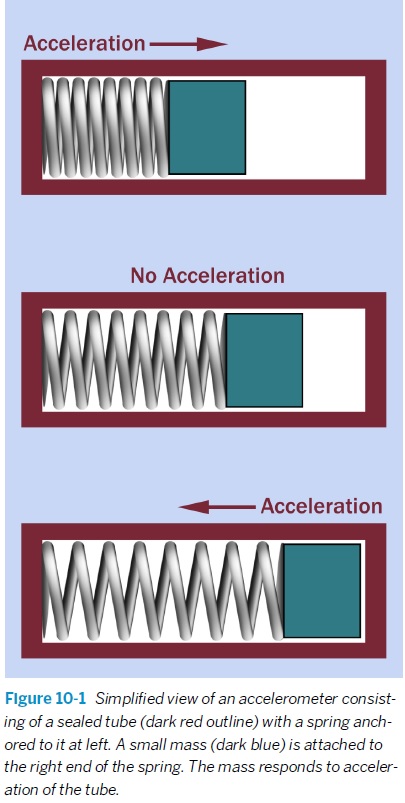
[출처: Encyclopedia of Electronic Components Volume 3 Sensors for Location, Presence, Proximity, Orientation, Oscillation, Force, Load, Human Input, Liquid ... Light, Heat, Sound, and Electricity]
★ acceleration gauge
★ G-meter
★ G-meter