도가니로
★ crucible furnace 도가니로.
* These furnaces melt the metal without direct contact with a burning fuel mixture. For this reason, they are sometimes called indirect fuel-fired furnaces. Three types of crucible furnaces are used in foundries: (a) lift-out type, (b) stationary, and (c) tilting, illustrated in Figure 11.21. They all utilize a container (the
crucible) made out of a suitable refractory material (e.g., a clay–graphite mixture) or high-temperature steel alloy to hold the charge. In the lift-out crucible furnace, the crucible is placed in a furnace and heated suffi ciently to melt the metal charge. Oil, gas, or powdered coal are typical fuels for these furnaces. When the metal is melted, the crucible is lifted out of the furnace and used as a pouring ladle. The other two types, sometimes referred to as pot furnaces, have the heating furnace and container as one integral unit. In the stationary pot furnace, the furnace is stationary and the molten metal is ladled out of the container. In the tilting-pot furnace, the entire assembly can be tilted for pouring. Crucible furnaces are used for nonferrous metals such as bronze, brass, and alloys of zinc and aluminum. Furnace capacities are generally limited to
several hundred pounds.
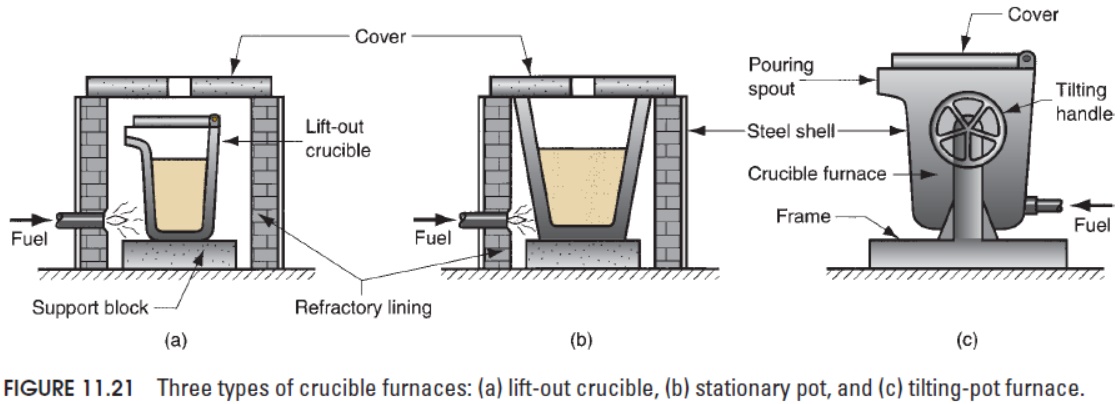
[출처: Mikell P. Groover, Fundamentals of Modern Manufacturing Materials, Processes, and Systems]