라이오셀
★ lyocell [섬유] 라이오셀(환원 셀루로스로만든 강한 합성 섬유; 다른 섬유와 혼방하여 카펫·의류에 사용).
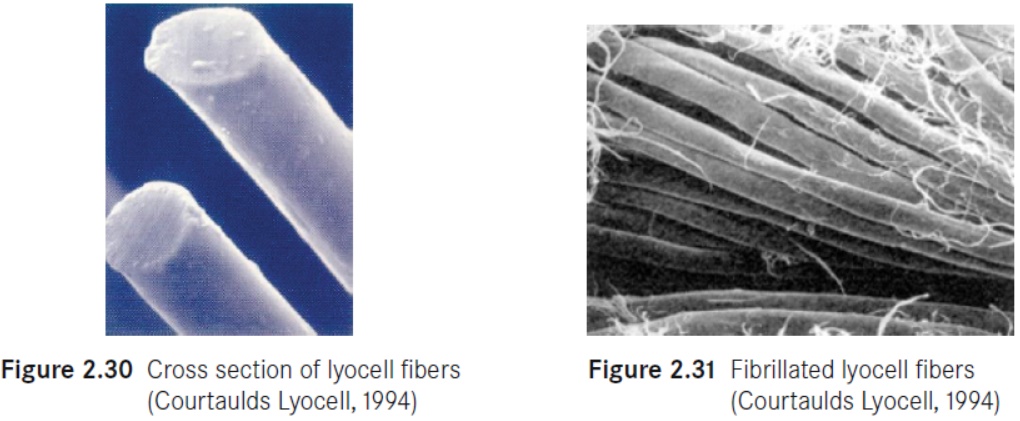
Lyocell fibers consist entirely of cellulose. One fiber is composed of uniformly thick fibrils distributed over the whole cross section. This structure is another difference from the traditional fibers from regenerated cellulose, which is usually characterized by a core-sheath structure. The evolution of this fibrillar structure can be explained by the rapid segregation processes occurring during the regeneration of the cellulose from the spinning solution. This structure (Fig. 2.30) imparts the particular properties of the lyocell fiber.
In contrast to conventional cellulosic chemical fibers, lyocell fibers are manufactured without production of a cellulose derivate in either the dissolution or the actual spinning of the cellulose. The name lyocell fibers comprises all fibers that are solvent-spun cellulosics. By definition, an organic solvent applied in the solvent-spinning production process consists of a mix of chemicals in water.
The development of this relatively new fiber was motivated by the goal to minimize the environmental impact of the manufacturing process and at the same time attain or even improve the properties of certain traditional cellulosic products.
The development of this relatively new fiber was motivated by the goal to minimize the environmental impact of the manufacturing process and at the same time attain or even improve the properties of certain traditional cellulosic products.
The name lyocell is a combination of “lyo” from the Greek lyein = dissolve (Falbe et al, 1990) and “cell” from cellulose.
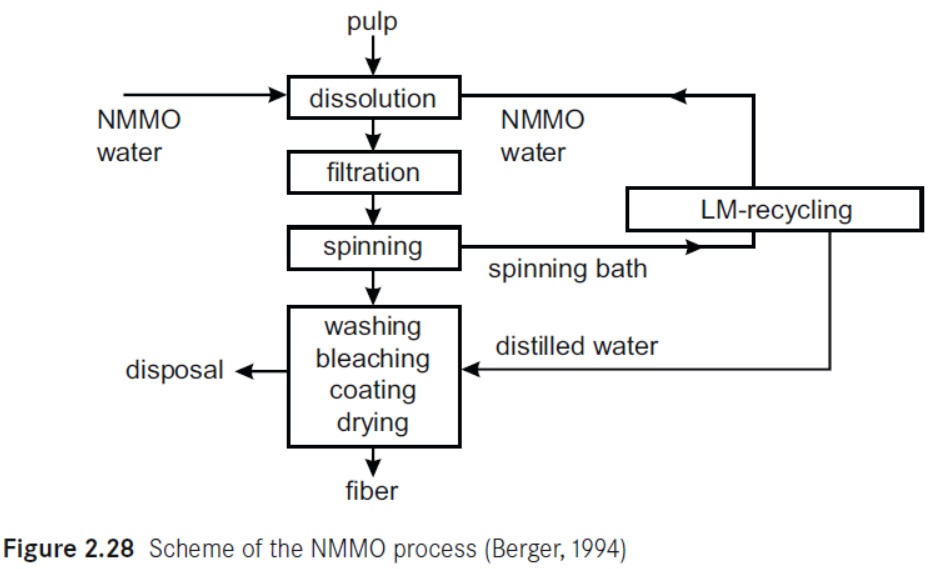
Among a variety of procedures, the only technically mature process to manufacture lyocell fibers is the NMMO process, commercialized in 1993. This process applies the solvent NMMO (N-methyl-morpholine-N-oxide). Figure 2.28 depicts the procedure of the NMMO process, which consists of three steps:
1. Production of a homogeneous solution of pulp, NMMO, and water. It is necessary to prepare the already activated raw material for mixing with the solvent. The cellulose needs to be disintegrated into various sizes. The mixing of the cellulosic material and the solvent leads to a suspension that is the starting point for the production of the solution (Fig. 2.29). This solution has to be stabilized.
2. Deformation and molding of fibers and fabrics by pulling the fibers through a spinneret, followed by washing, drying, and winding up.
3. Recycling of the NMMO (from the regeneration and the washing process) with a recirculation to the solvent production.
[출처: Thomas Gries et al., Textile Technology, 2nd Ed., HANSER]