레이저 다이오드
★ laser diode (=LD)
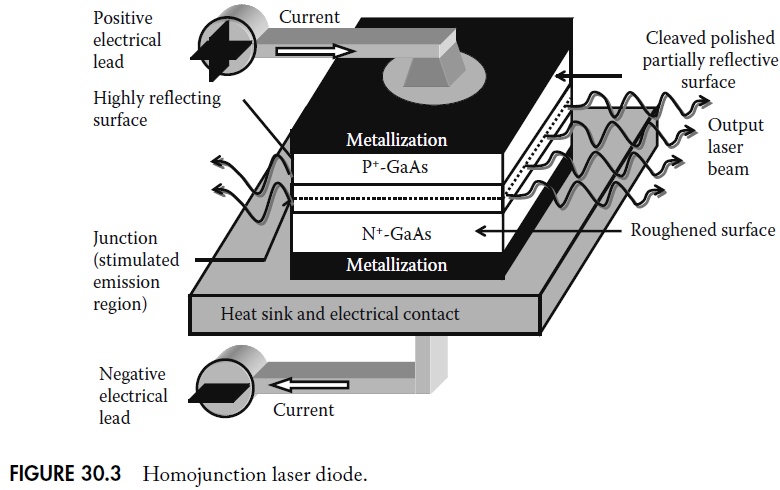
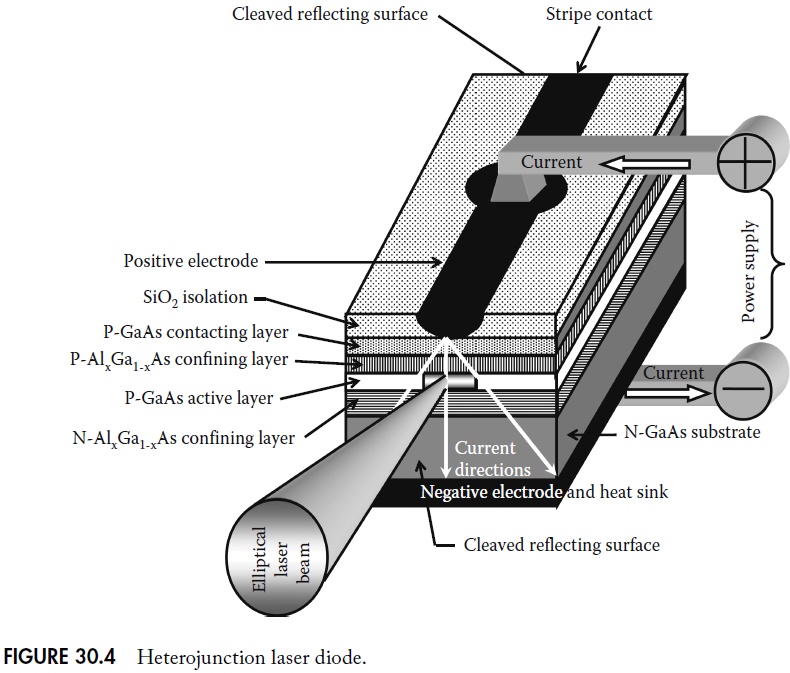
[출처: Vinod Kumar Khanna, Fundamentals of Solid-State Lighting LEDs, OLEDs, and Their Applications in Illumination and Displays]
A laser diode contains an LED. The p-n junction of the diode functions as the resonant cavity of the laser.
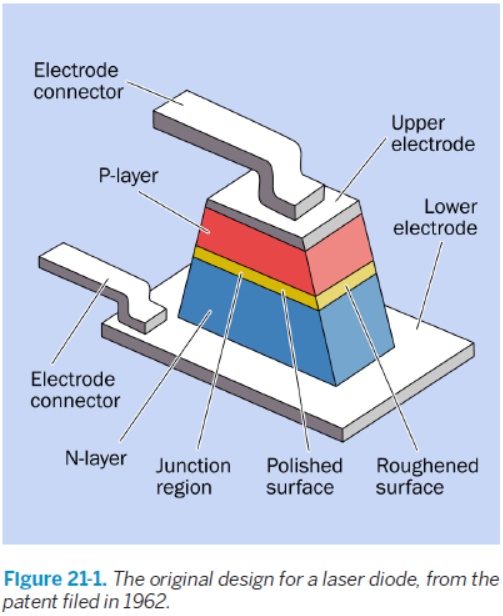
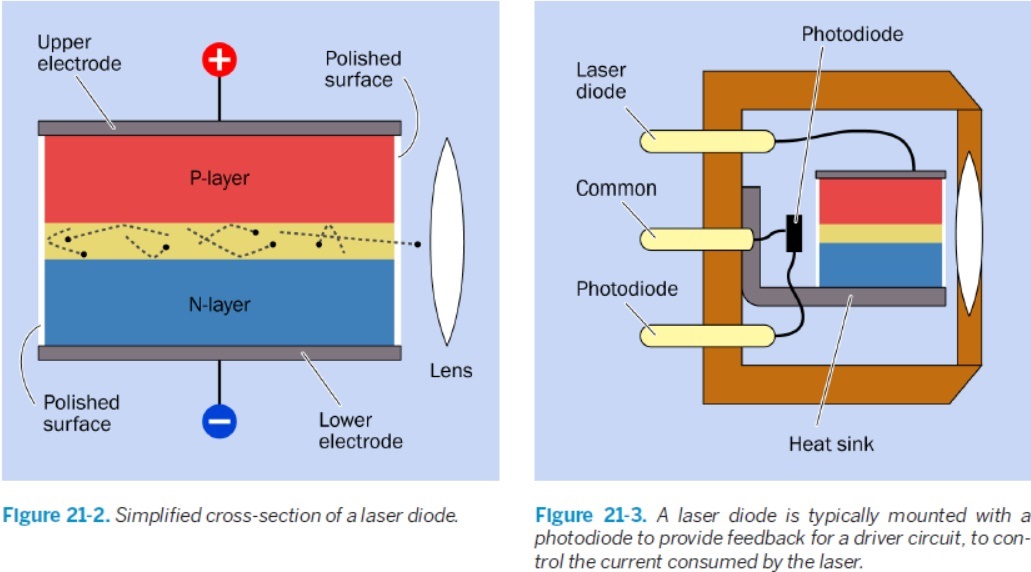
Forward bias injects charges into the junction, causing spontaneous emission of photons. The photons, in turn, cause other electrons and electron-holes to combine, creating more photons in the process of stimulated emission. When this process crosses a threshold level, current passing through the diode causes it to lase. The original patent for a laser diode was filed by Robert N. Hall of General Electric in 1962, and the diagram in Figure 21-1 is derived from the drawing in that patent, with color added for clarity.
Forward bias injects charges into the junction, causing spontaneous emission of photons. The photons, in turn, cause other electrons and electron-holes to combine, creating more photons in the process of stimulated emission. When this process crosses a threshold level, current passing through the diode causes it to lase. The original patent for a laser diode was filed by Robert N. Hall of General Electric in 1962, and the diagram in Figure 21-1 is derived from the drawing in that patent, with color added for clarity.
[출처: Charles Platt, Encyclopedia of Electronic Components Volume 2 LEDs, LCDs, Audio, Thyristors, Digital Logic, and Amplification]