미립자화
★ atomization 원자화; 미립자화
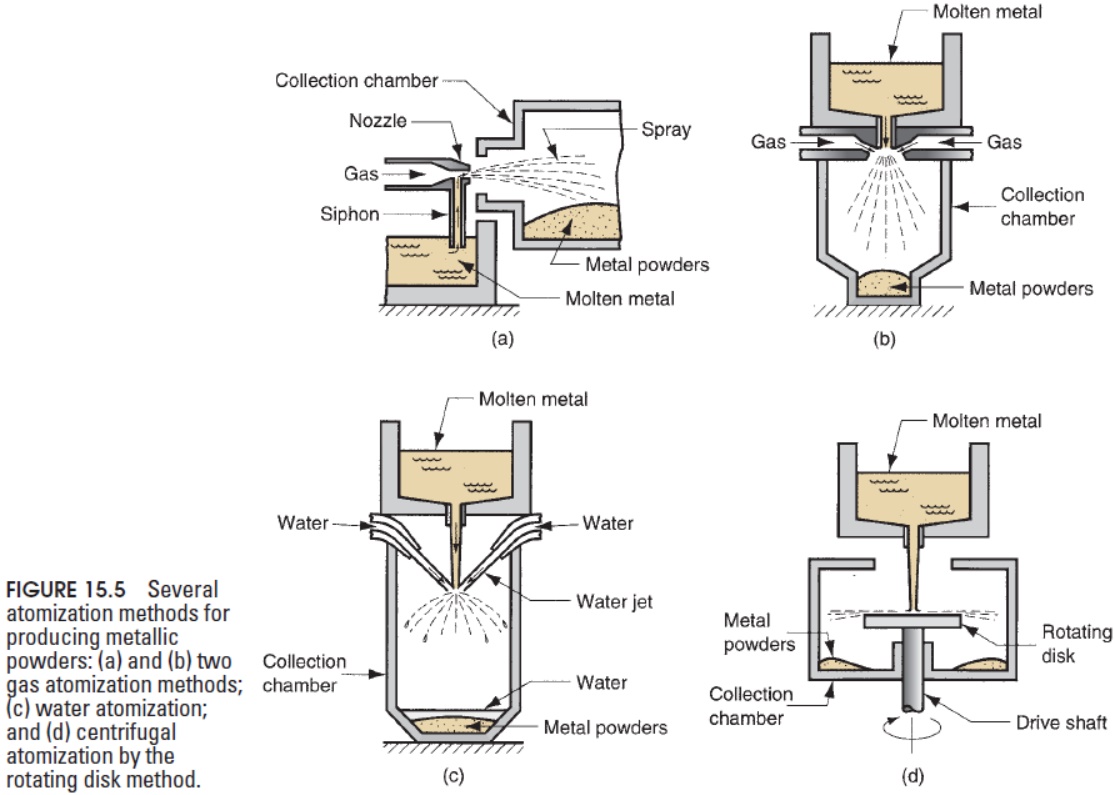
* This method involves the conversion of molten metal into a spray of droplets that solidify into powders. It is the most versatile and popular method for producing metal powders today, applicable to almost all metals, alloys as well as pure metals. There in Figure 15.5. Two of the methods shown are based on gas atomization, in which a high velocity gas stream (air or inert gas) is utilized to atomize the liquid metal. In
Figure 15.5(a), the gas fl ows through an expansion nozzle, siphoning molten metal from the melt below and spraying it into a container. The droplets solidify into powder form. In a closely related method shown in Figure 15.5(b), molten metal fl ows by gravity through a nozzle and is immediately atomized by air jets. The resulting metal powders, which tend to be spherical, are collected in a chamber below. The approach shown in Figure 15.5(c) is similar to (b), except that a high-velocity water stream is used instead of air. This is known as water atomization and is the most common of the atomization methods, particularly suited to metals that melt below 1600°C (2900°F). Cooling is more rapid, and the resulting powder shape is irregular rather than spherical. The disadvantage of using water is oxidation on the particle surface. A recent innovation involves the use of synthetic oil rather than water to reduce oxidation. In both air and water atomization processes, particle size is controlled largely by the velocity of the fl uid stream; particle size is inversely related to velocity. Several methods are based on centrifugal atomization. In one approach, the rotating disk method shown in Figure 15.5(d), the liquid metal stream pours onto a rapidly rotating disk that sprays the metal in all directions to produce powders.
Figure 15.5(a), the gas fl ows through an expansion nozzle, siphoning molten metal from the melt below and spraying it into a container. The droplets solidify into powder form. In a closely related method shown in Figure 15.5(b), molten metal fl ows by gravity through a nozzle and is immediately atomized by air jets. The resulting metal powders, which tend to be spherical, are collected in a chamber below. The approach shown in Figure 15.5(c) is similar to (b), except that a high-velocity water stream is used instead of air. This is known as water atomization and is the most common of the atomization methods, particularly suited to metals that melt below 1600°C (2900°F). Cooling is more rapid, and the resulting powder shape is irregular rather than spherical. The disadvantage of using water is oxidation on the particle surface. A recent innovation involves the use of synthetic oil rather than water to reduce oxidation. In both air and water atomization processes, particle size is controlled largely by the velocity of the fl uid stream; particle size is inversely related to velocity. Several methods are based on centrifugal atomization. In one approach, the rotating disk method shown in Figure 15.5(d), the liquid metal stream pours onto a rapidly rotating disk that sprays the metal in all directions to produce powders.
[출처: Mikell P. Groover, Fundamentals of Modern Manufacturing Materials, Processes, and Systems]