이온 도금
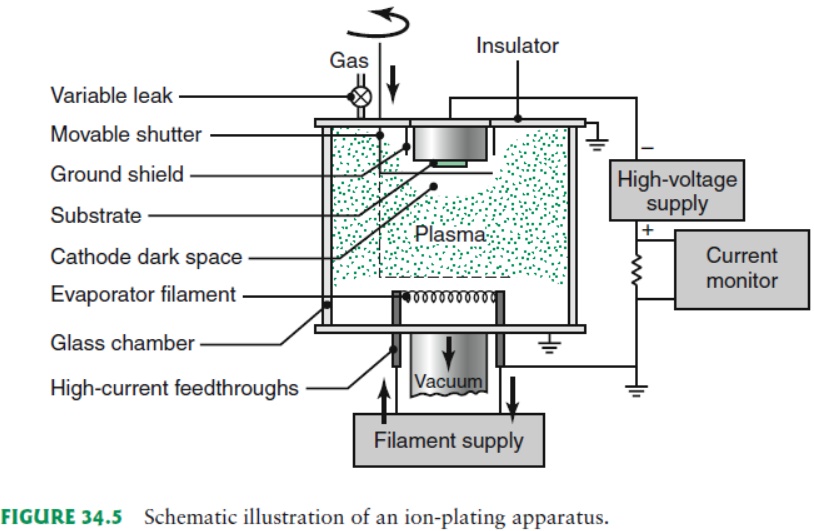
[Source: Serope Kalpakjian, Steven R. Schmid, Manufacturing Engineering and Technology]
★ ion plating 이온 도금, 이온 플레이팅.
Ion-Plating은 고체물질을 가열 혹은 입자를 충돌시켜 원자, 분자로 분해하고 다시 이것을 D.C나 R.F전원으로 이온화시켜 처리물질의 표면에 응축시켜서 박막을 형성하는 방법이다.
Ion plating uses a combination of sputtering and vacuum evaporation to deposit a thin fi lm onto a substrate. The process works as follows. The substrate is set up to be the cathode in the upper part of the chamber, and the source material is placed below it. A vacuum is then established in the chamber. Argon gas is admitted and an electric fi eld is applied to ionize the gas (Ar+) and establish a plasma. This results in ion bombardment (sputtering) of the substrate so that its surface is scrubbed to a condition of atomic cleanliness (interpret this as “very clean”).
Next, the source material is heated sufficiently to generate coating vapors. The heating methods used here are similar to those used in vacuum evaporation: resistance heating, electron beam bombardment, and so on. The vapor molecules pass through the plasma and coat the substrate. Sputtering is continued during deposition, so that the ion bombardment consists not only of the original argon ions but also source material ions that have been energized while being subjected to the same energy field as the argon. The effect of these processing conditions is to produce films of uniform thickness and excellent adherence to the substrate.
[출처: Mikell P. Groover, Fundamentals of Modern Manufacturing Materials, Processes, and Systems]