압축성형
★ compaction [분말 성형] 압축 (성형).
* In compaction, high pressure is applied to the powders to form them into the required shape. The conventional compaction method is pressing, in which opposing punches squeeze the powders contained in a die. The steps in the pressing cycle are shown in Figure 15.9. The work part after pressing is called a green compact, the word green meaning not yet fully processed. As a result of pressing, the density
of the part, called the green density, is much greater than the starting bulk density.
of the part, called the green density, is much greater than the starting bulk density.
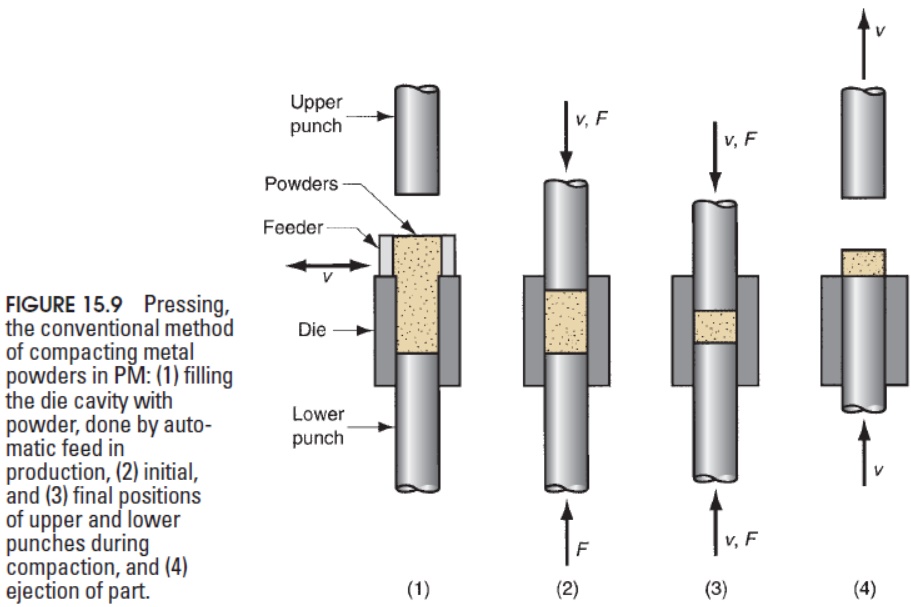
[출처: Mikell P. Groover, Fundamentals of Modern Manufacturing Materials, Processes, and Systems]
★ compression molding 압축 성형.
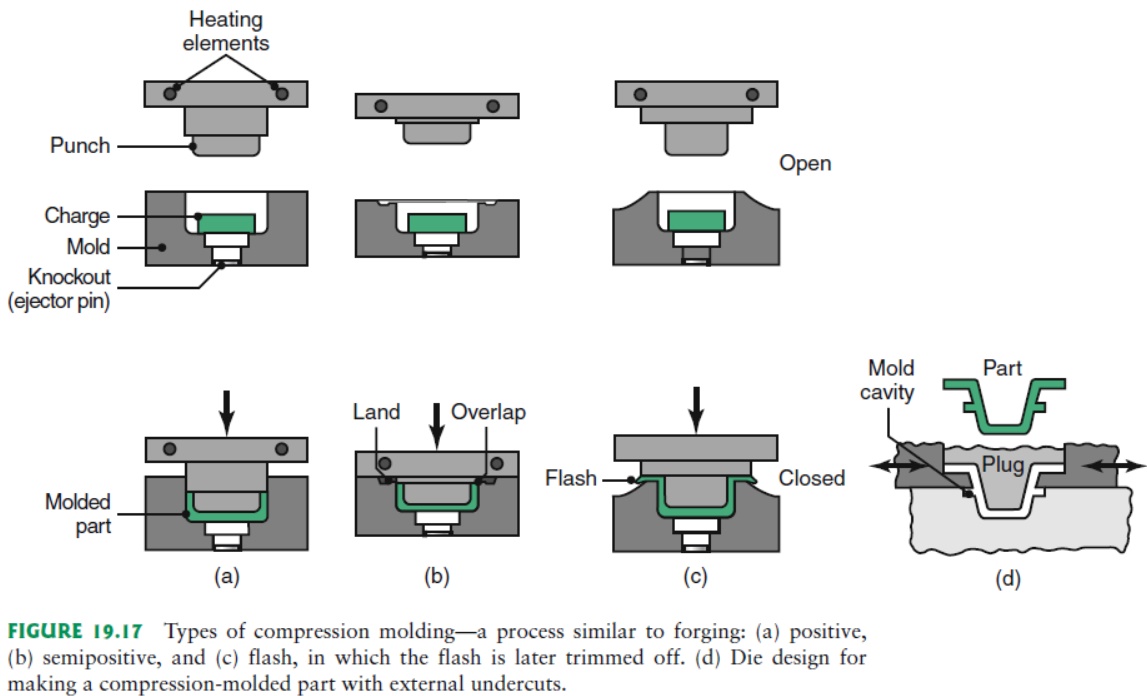
In compression molding, a preshaped charge of material, premeasured volume of powder, or viscous mixture of liquid-resin and filler material is placed directly into a heated mold cavity that typically is around 200°C (400°F) but can be much higher. Forming is done under pressure from a plug or from the upper half of the die (Fig. 19.17); thus, the process is somewhat similar to closed-die forging of metals.
Pressures range from about 10 to 150 MPa (1400 to 22,000 psi). As seen in Fig. 19.17, there is a flash formed, which subsequently is removed by trimming or by some other means. Typical parts made are dishes, handles, container caps, fittings, electrical and electronic components, washing-machine agitators, and housings. Fiber-reinforced parts with chopped fibers also are formed exclusively by this process.
Compression molding is used mainly with thermosetting plastics, with the original material being in a partially polymerized state. However, thermoplastics and elastomers are also processed by compression molding. Curing times range from about 0.5 to 5 minutes, depending on the material and on part thickness and shape. The thicker the material, the longer it will take to cure.
[Source: Serope Kalpakjian, Steven R. Schmid, Manufacturing Engineering and Technology]