모형 (模型)
★ mock-up 실물 크기의 모형(模型).
★ model (실물을 본떠 만든) 모형, 본.
★ model (실물을 본떠 만든) 모형, 본.
* a working model (of something)(⋯의) 실용 모형, 운전 모형.
* a scale model 축척 모형.
* build a model (of something)(⋯의) 모형을 만들다[조립하다].
* They showed us a model of the building. 그들은 건물 모형을 우리에게 보여주었다.
★ pattern [주조] 모형(模型).
[뜻] 모형이란 주조(casting) 제품의 형상과 유사한 형상을 가지면서, 주물(mould)을 만들기 위해 주형(mould)에 사용되는 형을 말한다.
* Sand casting requires a pattern—a full-sized model of the part, enlarged to account for shrinkage and machining allowances in the fi nal casting. Materials used to make patterns include wood, plastics, and metals. Wood is a common pattern material because it is easily shaped. Its disadvantages are that it tends to warp, and it is abraded by the sand being compacted around it, thus limiting the number of times it can be reused. Metal patterns are more expensive to make, but they last much longer. Plastics represent a compromise between wood and metal. Selection of the appropriate pattern material depends to a large extent on the total quantity of castings to be made. . . .
Split patterns consist of two pieces, dividing the part along a plane coinciding with the parting line of the mold. Split patterns are appropriate for complex part geometries and moderate production quantities. The parting line of the mold is predetermined by the two pattern halves, rather than by operator judgment.
For higher production quantities, match-plate patterns or cope-and-drag patterns are used. In match-plate patterns, the two pieces of the split pattern are attached to opposite sides of a wood or metal plate. Holes in the plate allow the top and bottom (cope and drag) sections of the mold to be aligned accurately. Cope-anddrag patterns are similar to match-plate patterns except that split pattern halves are attached to separate plates, so that the cope and drag sections of the mold can be fabricated independently, instead of using the same tooling for both. Part (d) of the figure includes the gating and riser system in the cope-and-drag patterns.
For higher production quantities, match-plate patterns or cope-and-drag patterns are used. In match-plate patterns, the two pieces of the split pattern are attached to opposite sides of a wood or metal plate. Holes in the plate allow the top and bottom (cope and drag) sections of the mold to be aligned accurately. Cope-anddrag patterns are similar to match-plate patterns except that split pattern halves are attached to separate plates, so that the cope and drag sections of the mold can be fabricated independently, instead of using the same tooling for both. Part (d) of the figure includes the gating and riser system in the cope-and-drag patterns.
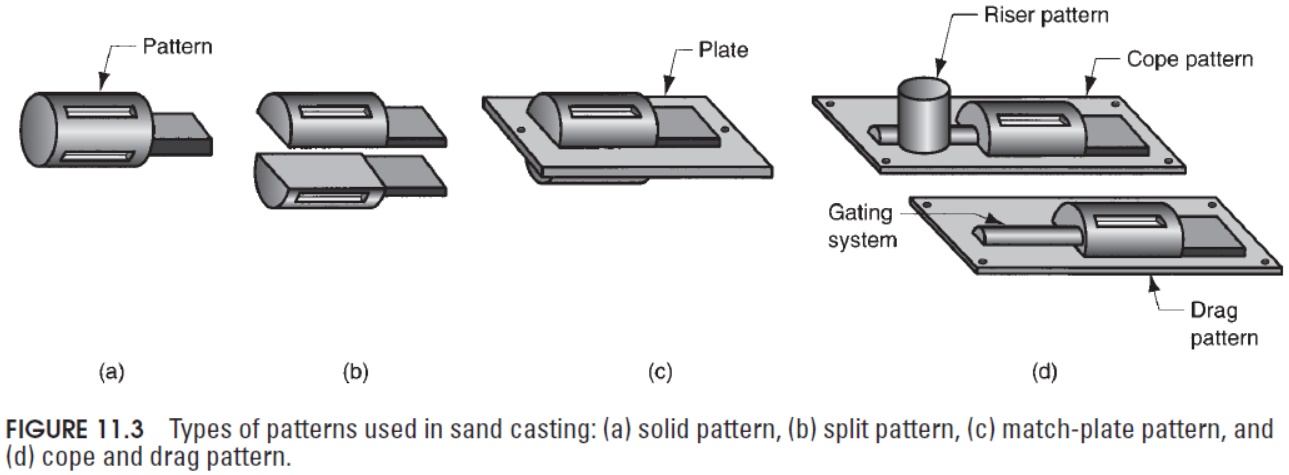
[출처: Mikell P. Groover, Fundamentals of Modern Manufacturing Materials, Processes, and Systems]