인서트
★ insert [공구] 인서트.
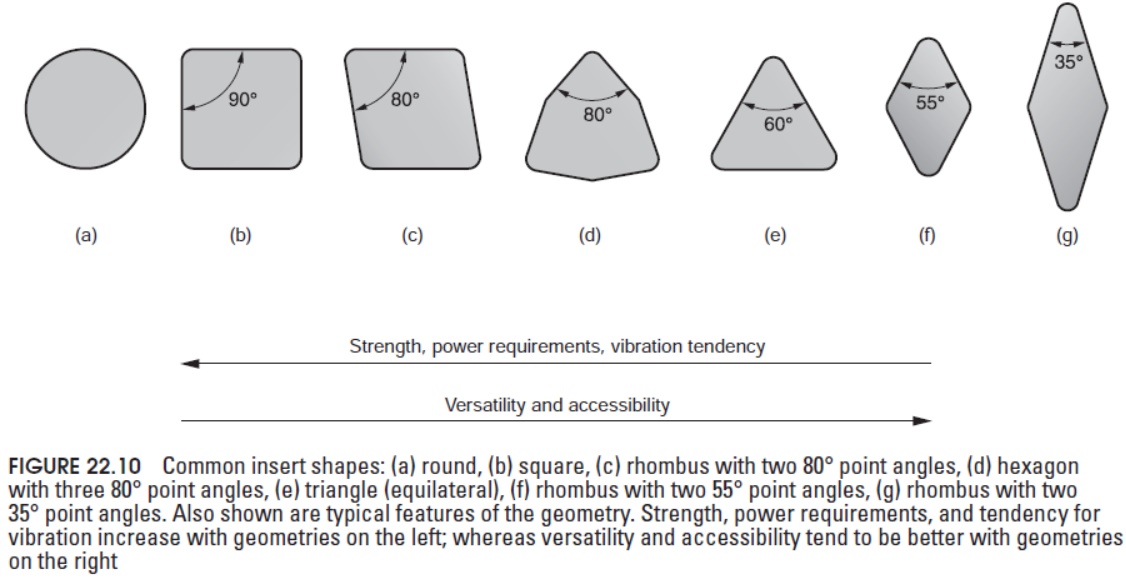
Cutting-tool inserts are widely used in machining because they are economical and adaptable to many different types of machining operations: turning, boring, threading, milling, and even drilling. They are available in a variety of shapes and sizes for the variety of cutting situations encountered in practice. A square insert is shown in Figure 22.9(c). Other common shapes used in turning operations are displayed in Figure 22.10. In general, the largest point angle should be selected for strength and economy. Round inserts possess large point angles (and large nose radii) just because of their shape. Inserts with large point angles are inherently stronger and less likely to chip or break during cutting, but they require more power, and there is a greater likelihood of vibration. The economic advantage of round inserts is that they can be indexed multiple times for more cuts per insert. Square inserts present four cutting edges, triangular shapes have three edges, whereas rhombus shapes have only two. Fewer edges are a cost disadvantage. If
both sides of the insert can be used (e.g., in most negative rake angle applications), then the number of cutting edges is doubled. Rhombus shapes are used (especially with acute point angles) because of their versatility and accessibility when a variety of operations are to be performed. These shapes can be more readily positioned in tight spaces and can be used not only for turning but also for facing, Figure 21.6(a),
and contour turning, Figure 21.6(c).
[출처: Mikell P. Groover, Fundamentals of Modern Manufacturing Materials, Processes, and Systems]