몰질량
★ molar mass 몰 질량.
* Although chemists often wish to combine substances in specific mole ratios, there is no direct way to measure the number of moles in a sample of matter. Instead, chemists determine how many moles there are of a substance by measuring its mass (usually in grams). The molar mass of the substance is then used to convert from grams to moles. The molar mass (ℳ) of a substance is the mass in grams of 1 mole of the substance. By definition, the mass of a mole of carbon-12 is exactly 12 g. Note that the molar mass of carbon is numerically equal to its atomic mass. Likewise, the atomic mass of calcium is 40.08 amu and its molar mass is 40.08 g, the atomic mass of sodium is 22.99 amu and its molar mass is 22.99 g, and so on. In general, an element’s molar mass in grams is numerically equal to its atomic mass in atomic mass units.
* In effect, there is 1 mole of atomic mass units in a gram. The molar mass (in grams) of any compound is numerically equal to its molecular or formula mass (in amu). The molar mass of water, for example, is 18.02 g, and the molar mass of sodium chloride (NaCl) is 58.44 g.
* Although the term molar mass specifies the mass of 1 mole of a substance, making the appropriate units simply grams (g), we usually express molar masses in units of grams per mole (g/mol) to facilitate calculations involving moles.
* Molar mass is the conversion factor that we use to convert from mass (m) to moles (n), and vice versa. We use Avogadro’s number to convert from number of moles to number of particles (N), and vice versa. Particles in this context may refer to atoms, molecules, ions, or formula units. Figure 3.4 summarizes the operations involved in these conversions.
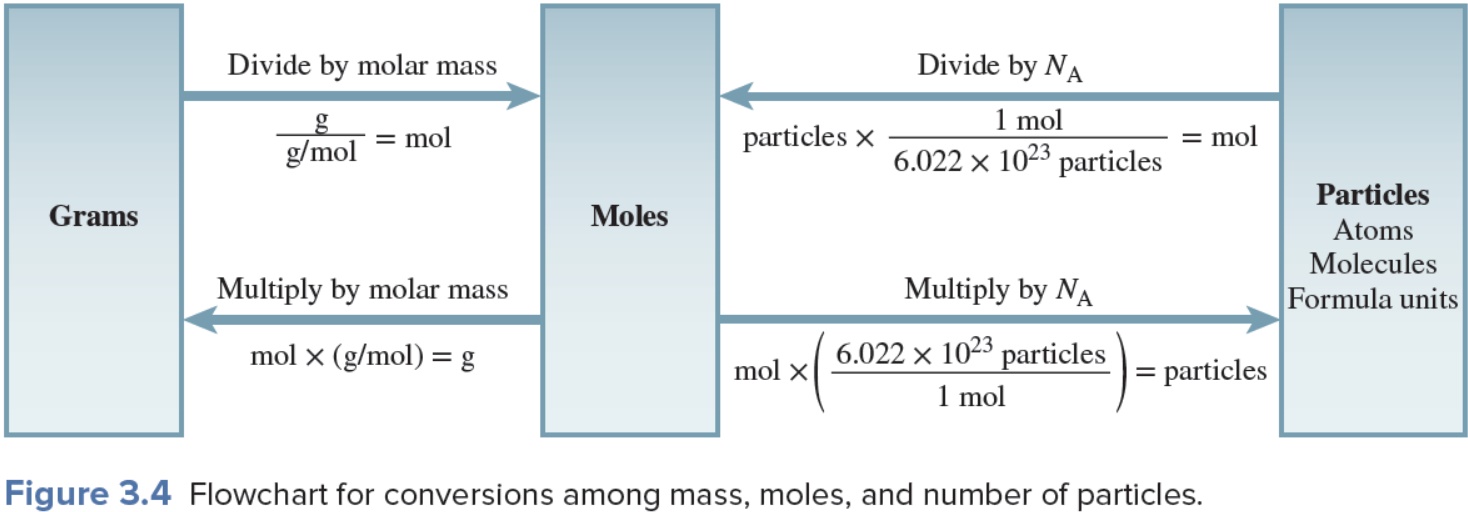
[출처: Chemistry by Julia R. Burdge]