서브머지드 아크 용접
★ Submerged Arc Welding (SAW)
This process, developed during the 1930s, was one of the first AW processes to be automated. Submerged arc welding (SAW) is an arcwelding process that uses a continuous, consumable bare wire electrode, and arc shielding is provided by a cover of granular fl ux. The electrode wire is fed automatically from a coil into the arc. The fl ux is introduced into the joint slightly ahead of the weld arc by gravity from a hopper, as shown in Figure 29.8. The blanket of granular flux completely submerges the welding operation, preventing sparks, spatter, and radiation that are so hazardous in other AW processes. Thus, the welding operator in SAW need not wear the somewhat cumbersome face shield required in the other operations (safety glasses and protective gloves, of course, are required). The portion of the fl ux closest to the arc is melted, mixing with the molten weld metal to remove impurities and then solidifying on top of the weld joint to form a glass-like slag. The slag and unfused fl ux granules on top provide good protection from the atmosphere and good thermal insulation for the weld area, resulting in relatively slow cooling and a high-quality weld joint, noted for toughness and ductility. As depicted in the sketch, the unfused fl ux remaining after welding can be recovered and reused. The solid slag covering the weld must be chipped away, usually by manual means.
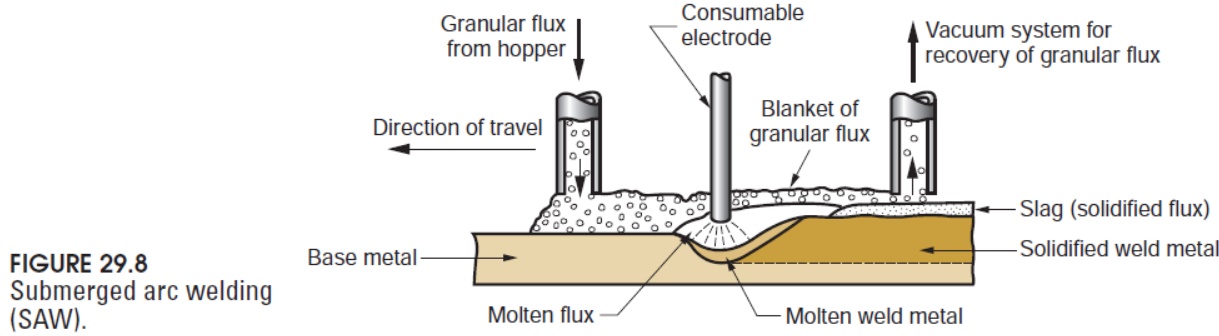
[출처: Mikell P. Groover, Fundamentals of Modern Manufacturing Materials, Processes, and Systems]