3차원 프린팅
★ Three-Dimensional Printing
This technology (3DP) builds the part using an inkjet printer to eject adhesive bonding material onto successive layers of powders. The binder is deposited in areas corresponding to the cross sections of the solid part, as determined by slicing the CAD geometric model into layers. The binder holds the powders together to form the solid part, whereas the unbonded powders remain loose to be removed later. While the loose powders are in place during the build process, they serve to support overhanging and fragile features of the part. When the build process is complete, the loose powders are removed. To further
strengthen the part, a sintering step can be applied to bond the individual powders. The part is built on a platform whose level is controlled by a piston. Consider the process for one cross section with reference to Figure 32.6: (1) A layer of powder is spread on the existing part-in-process. (2) An ink-jet printing head moves across the surface using a line-wise channel mode, ejecting droplets of binder on those regions that are to become the solid part. (3) When the printing of the current layer is completed, the piston lowers the platform for the next layer. Starting materials in 3DP are powders of ceramic, metal, or cermet, and binders
that are polymeric or colloidal silica or silicon carbide [12], [19]. Typical layer thickness ranges from about 0.10 to 0.20 mm (0.004–0.008 in). The ink-jet printing head moves across the layer at a speed of about 1.5 m/sec (59 in/sec), with ejection of liquid binder determined during the sweep by raster scanning. The sweep time, together with the spreading of the powders, permits a cycle time per layer of about 2 seconds [19]. Allowing for repositioning and recoating delays, this permits the machine to operate at a rate of two to four layers per minute [4].
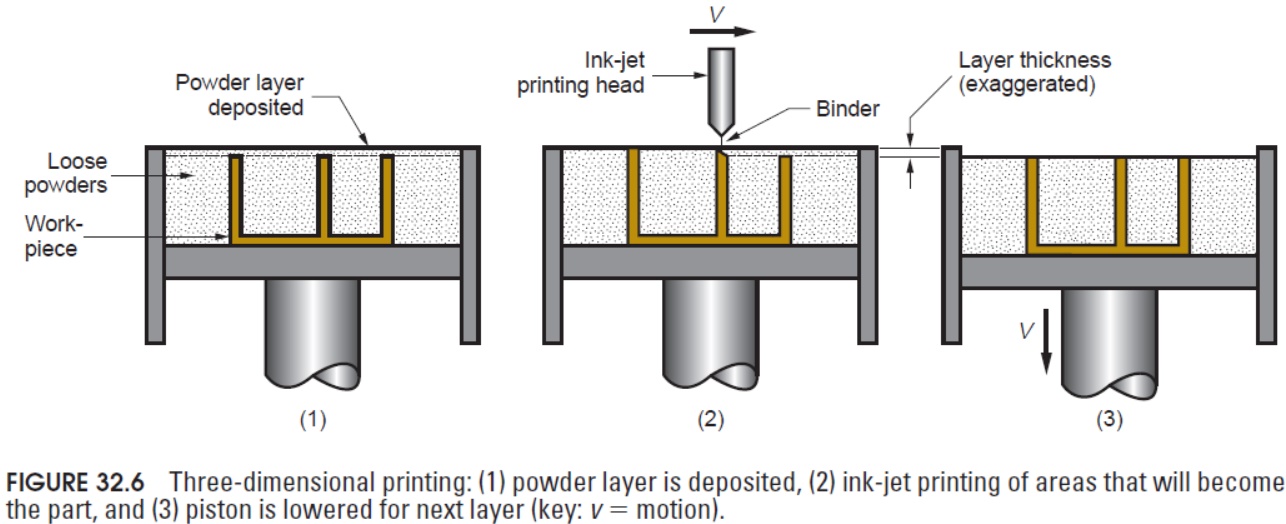
[출처: Mikell P. Groover, Fundamentals of Modern Manufacturing Materials, Processes, and Systems]