보링
★ boring [기계가공] 보링.
Boring is similar to turning. It uses a single-point tool against a rotating work part. The difference is that boring is performed on the inside diameter of an existing hole rather than the outside diameter of an existing cylinder. In effect, boring is an internal turning operation. Machine tools used to perform boring operations are called boring machines (also boring mills). One might expect that boring machines would
have features in common with turning machines; indeed, as previously indicated, lathes are sometimes used to accomplish boring.
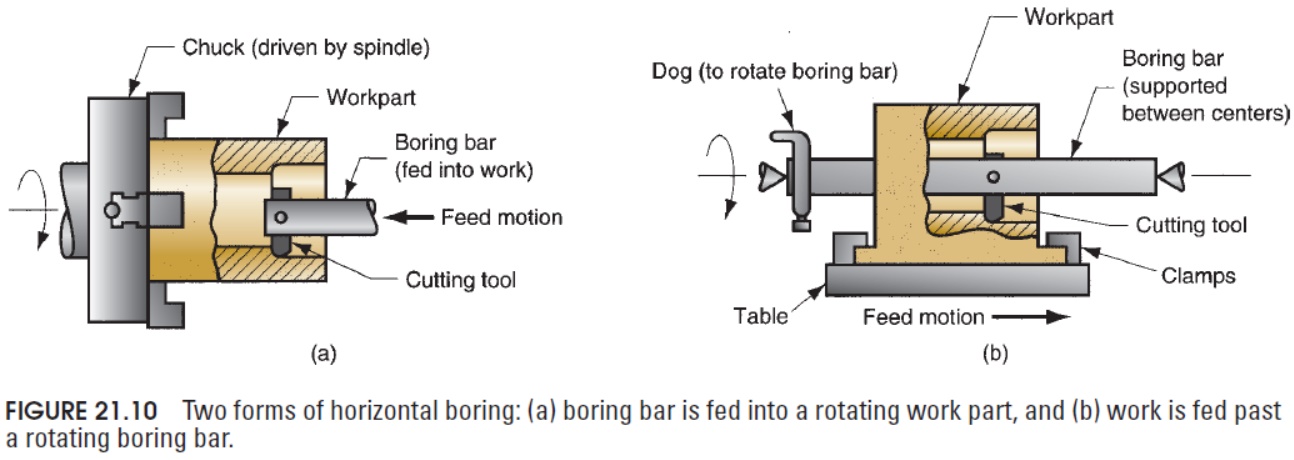
Boring mills can be horizontal or vertical. The designation refers to the orientation of the axis of rotation of the machine spindle or work part. In a horizontal boring operation, the setup can be arranged in either of two ways. The fi rst setup is one in which the work is fi xtured to a rotating spindle, and the tool is attached to a cantilevered boring bar that feeds into the work, as illustrated in Figure 21.10(a).
[출처: Mikell P. Groover, Fundamentals of Modern Manufacturing Materials, Processes, and Systems]