브로칭
★ broaching [기계가공] 브로칭.
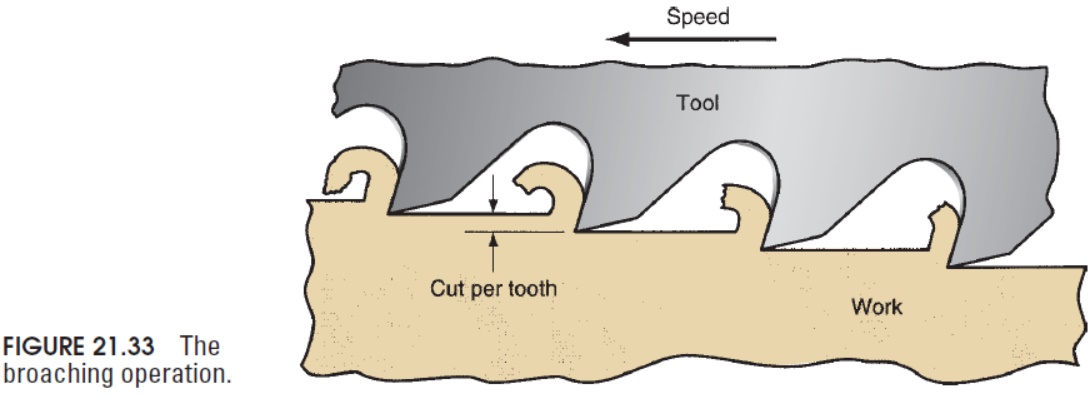
Broaching is performed using a multiple teeth cutting tool by moving the tool linearly relative to the work in the direction of the tool axis, as in Figure 21.33. The machine tool is called a broaching machine, and the cutting tool is called a broach. Aspects of broach geometry are discussed in Section 22.3.2. In certain jobs for which broaching can be used, it is a highly productive method of machining. Advantages include good surface finish, close tolerances, and a variety of work shapes. Owing to the complicated and often custom-shaped geometry of the broach, tooling is expensive. There are two principal types of broaching: external (also called surface broaching) and internal. External broaching is performed on the outside surface of the
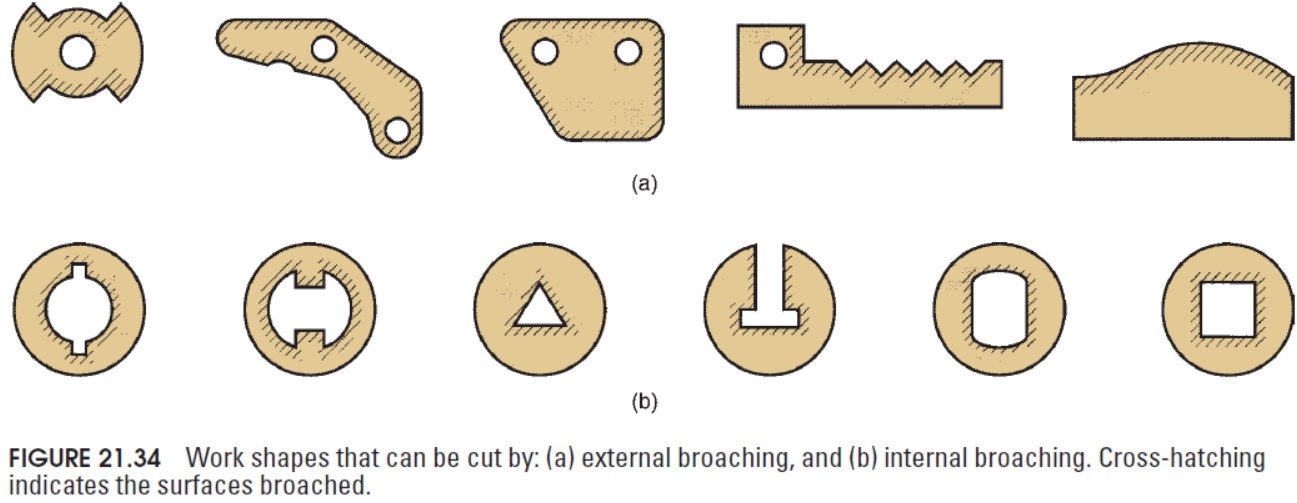
work to create a certain cross-sectional shape on the surface. Figure 21.34(a) shows some possible cross sections that can be formed by external broaching. Internal broaching is accomplished on the internal surface of a hole in the part. Accordingly, a starting hole must be present in the part so as to insert the broach at the beginning of the broaching stroke. Figure 21.34(b) indicates some of the shapes that can be
produced by internal broaching.
[출처: Mikell P. Groover, Fundamentals of Modern Manufacturing Materials, Processes, and Systems]