사형주조법
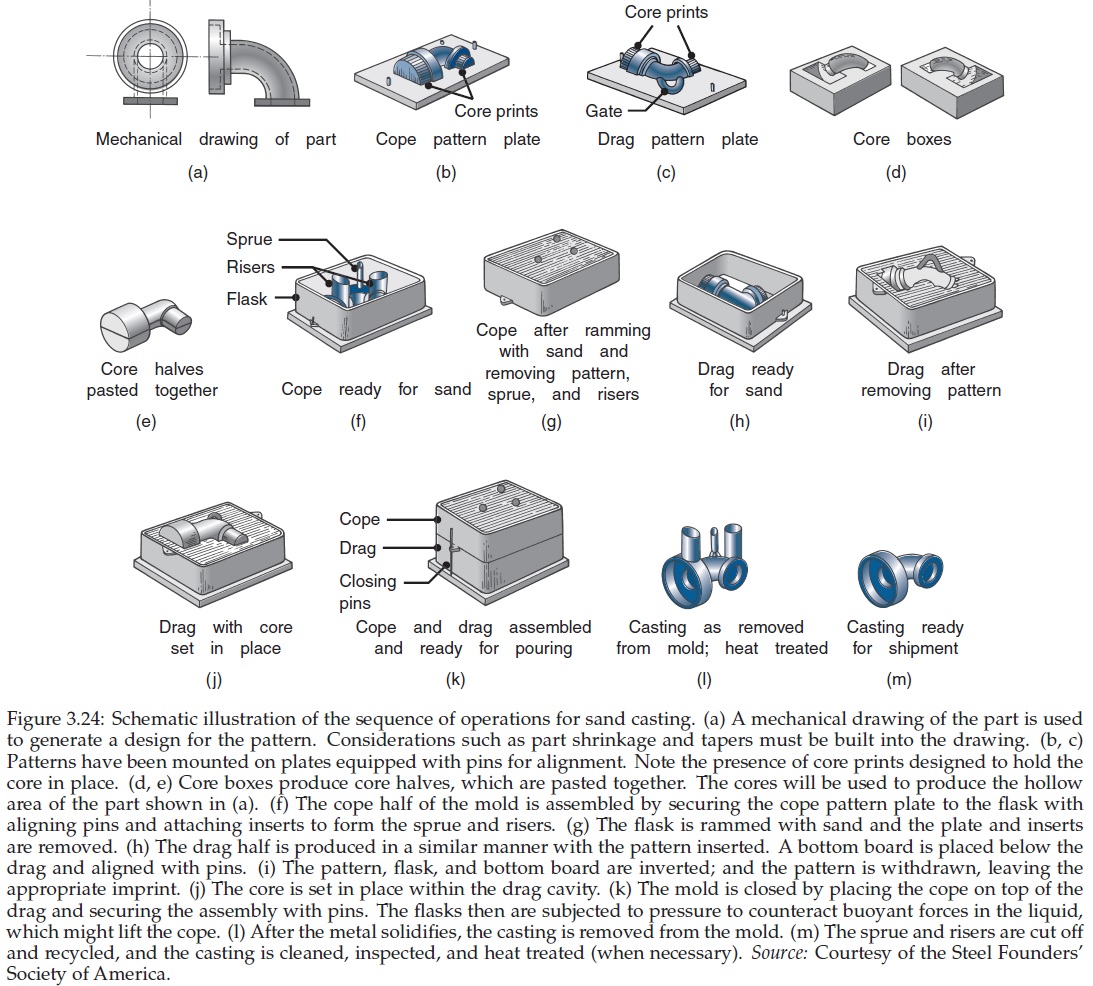
[Source: Steven R. Schmid, Bernard J. Hamrock, Bo O. Jacobson - Fundamentals of Machine Elements_ SI Version (2014, CRC Press)]
★ sand casting 사형(砂型)주조.
* Sand casting is by far the most important casting process. A sand-casting mold will be used to describe the basic features of a mold. Many of these features and terms are common to the molds used in other casting processes. Figure 10.2(b) shows the cross-sectional view of a typical sand-casting mold, indicating some of the terminology. The mold consists of two halves: cope and drag. The cope is the upper half of the mold, and the drag is the bottom half. These two mold parts are contained in a box, called a fl ask, which is also divided into two halves, one for the cope and the other for the drag. The two halves of the mold separate at the parting line. In sand casting (and other expendable mold processes) the mold cavity is formed by means of a pattern, which is made of wood, metal, plastic, or other material and has the shape of the part to be cast. The cavity is formed by packing sand around the pattern, about half each in the cope and drag, so that when the pattern is removed, the remaining void has the desired shape of the cast part. The pattern is usually made oversized to allow for shrinkage of the metal as it solidifi es and cools. The sand for the mold is moist and contains a binder to maintain its shape.
[출처: Mikell P. Groover, Fundamentals of Modern Manufacturing Materials, Processes, and Systems]