서보 모터
★ servo motor 서보 모터.
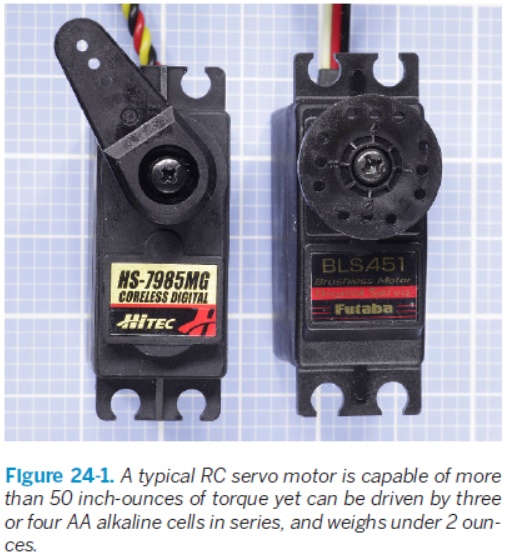
Should be referred to as an RC servo if it is intended for use in small devices that are remote-controlled and battery powered. However, in practice, the RC acronym is often omitted. A servo motor is actually a combination of a motor, reduction gearing, and miniaturized control electronics, usually packaged together inside a very compact sealed plastic case. The motor itself may be AC or DC, and if DC, it may be brushed or brushless. What distinguishes a servo from other types of motor is that it is not designed for continuous rotation. It is a position-seeking device. Its rotational range may be more than 180 degrees but will be significantly less than 360 degrees. Two typical RC servos are shown in Figure 24-1. A side view of a motor is shown in Figure 24-2. The electronics inside the motor enclosure interpret commands from an external controller. The command code specifies the desired turn angle measured as an offset either side of the center position of the motor’s range. The motor turns quickly to the specified position and stops there. So long as the command signal continues and power to the motor is sustained, the motor will hold its position and “push back” against any external turning force. In the absence of such a force, while the motor is stationary, it will use very little current.
[출처: Charles Platt, Encyclopedia of Electronic Components Volume 1 Resistors, Capacitors, Inductors, Switches, Encoders, Relays, Transistors]