소모 방적
★ worsted spinning 소모 방적(梳毛紡績)
[뜻] 5센티미터 이상의 긴 양모를 골라 가지런히 한 뒤에 실로 만드는 일.
In worsted yarn spinning, virgin wool and long-staple synthetic fibers, especially polyester and polyacrylonitrile, are processed. Worsted yarns are very uniform, have high tenacity and elongation, and have a low degree of hairiness. Typical products from worsted yarns are high-quality woven fabrics for men’s and women’s outerwear (for example, drapery, suit fabrics).
Before processing, wool has to be scoured to remove contaminating particles such as dirt, sweat, and wool fat. The wool is dried in perforated cylinder driers and then opened in the breaker card. After these stages the fibers are oiled to alter the frictional properties of the fibers and to prevent electrostatic charging. The fibers are then pneumatically transported to the mixing chamber. Because raw wool scouring
systems are very expensive and subject to strict environmental protection laws, most worsted spinning mills purchase scoured wool, card slivers, or combed slivers.
Synthetic fibers are delivered either as staple fibers in bales or as cables of continuous filaments. Staple fibers are opened, oiled, and fed directly to the card. Filament cables are converted into staple fibers first and then dyed or mixed as slivers without any previous carding or combing (tow-to-top principle, Fig. 3.32).
The next processing steps are carding and drawing. The doubled and attenuated sliver is processed into a combed top at the combing machine. The combing principle is the same as for cotton fibers explained in Section 3.1.2. The combing machines are substantially different because of the very different raw materials (crimp). To even out the soldering joints, the combed top is drawn with an autoleveller draw frame.
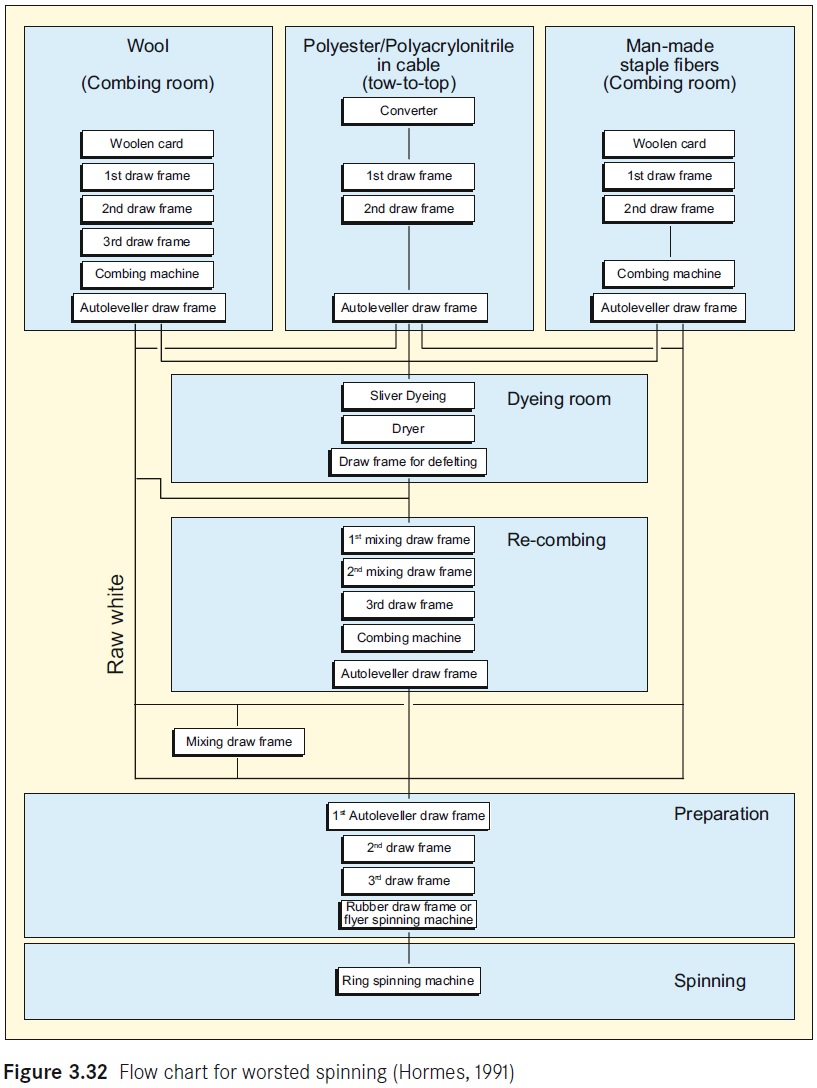
[출처: Thomas Gries et al., Textile Technology, 2nd Ed., HANSER]