연마 제트 가공
[source: Serope Kalpakjian, Steven R. Schmid , Manufacturing Engineering and Technology]
★ abrasive jet machining (AJM) 연마 제트 가공.
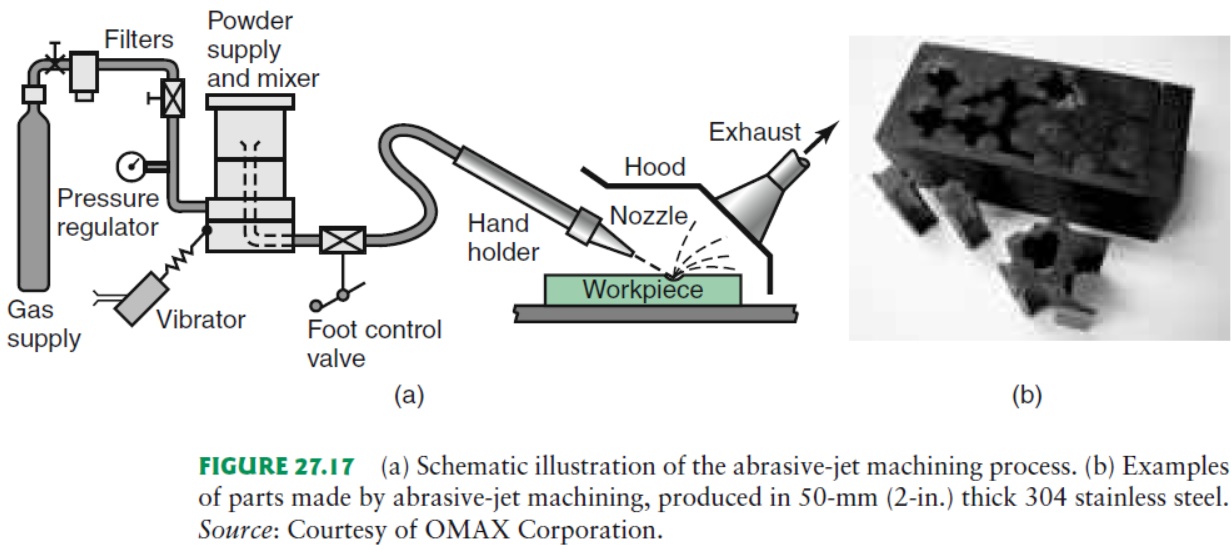
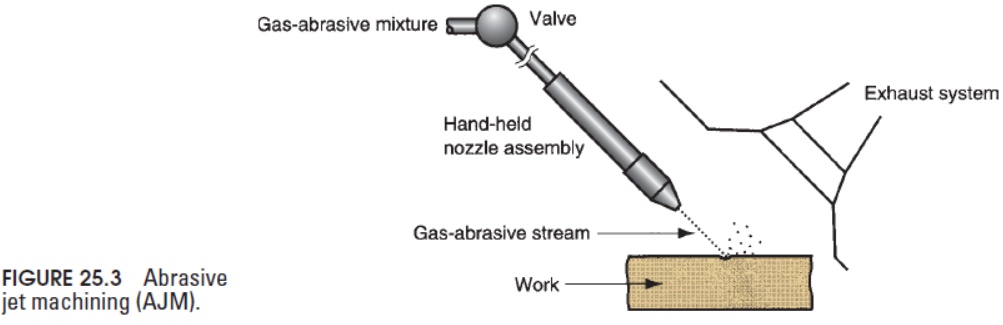
Not to be confused with AWJC is the process called abrasive jet machining (AJM), a material removal process caused by the action of a high-velocity stream of gas containing small abrasive particles, as in Figure 25.3. The gas is dry, and pressures of 0.2 to 1.4 MPa (25–200 lb/in2) are used to propel it through nozzle orifi ces of diameter 0.075 to 1.0 mm (0.003–0.040 in) at velocities of 2.5 to 5.0 m/s (500–1000 ft/min). Gases include dry air, nitrogen, carbon dioxide, and helium.
The process is usually performed manually by an operator who directs the nozzle at the work. Typical distances between nozzle tip and work surface range from 3 to 75 mm (0.125–3 in). The workstation must be set up to provide proper ventilation for the operator.
AJM is normally used as a fi nishing process rather than a production cutting process. Applications include deburring, trimming and defl ashing, cleaning, and polishing. Cutting is accomplished successfully on hard, brittle materials (e.g., glass, silicon, mica, and ceramics) that are in the form of thin fl at stock. Typical abrasives used in AJM include aluminum oxide (for aluminum and brass), silicon carbide (for stainless steel and ceramics), and glass beads (for polishing). Grit sizes are small, 15 to 40 mm (0.0006–0.0016 in) in diameter, and must be uniform in size for a given application. It is important not to recycle the abrasives because used grains become fractured (and therefore smaller in size), worn, and contaminated.
[출처: Mikell P. Groover, Fundamentals of Modern Manufacturing Materials, Processes, and Systems]