가스 텅스텐 아크 용접
[Source: Serope Kalpakjian, Steven R. Schmid, Manufacturing Engineering and Technology]
★ gas tungsten arc welding 가스 텅스텐 아크 용접.
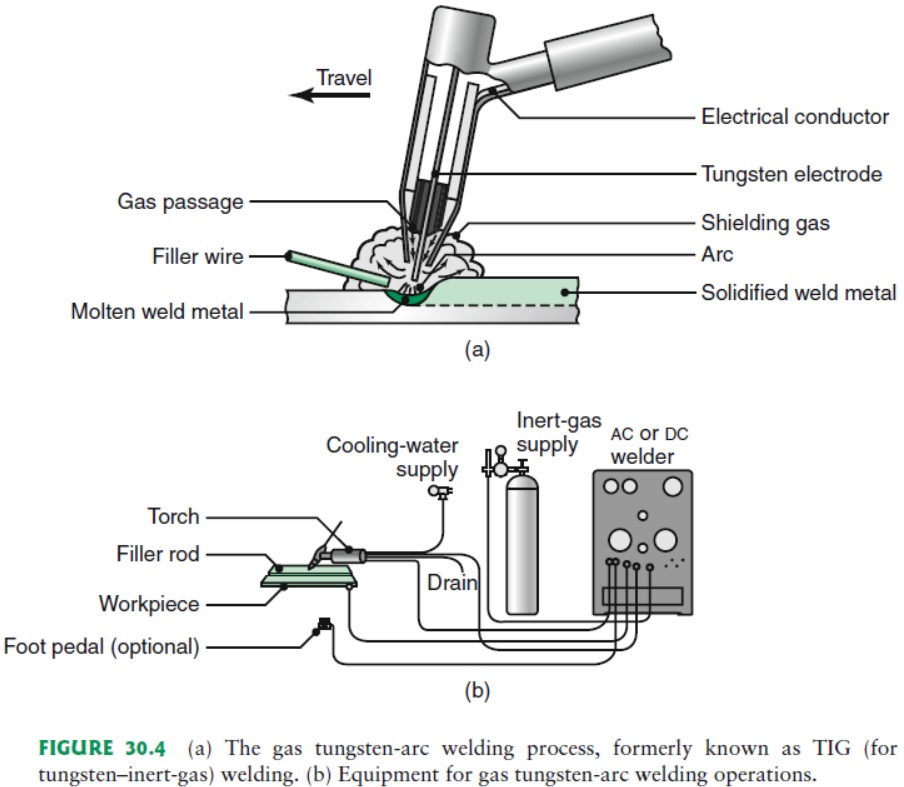
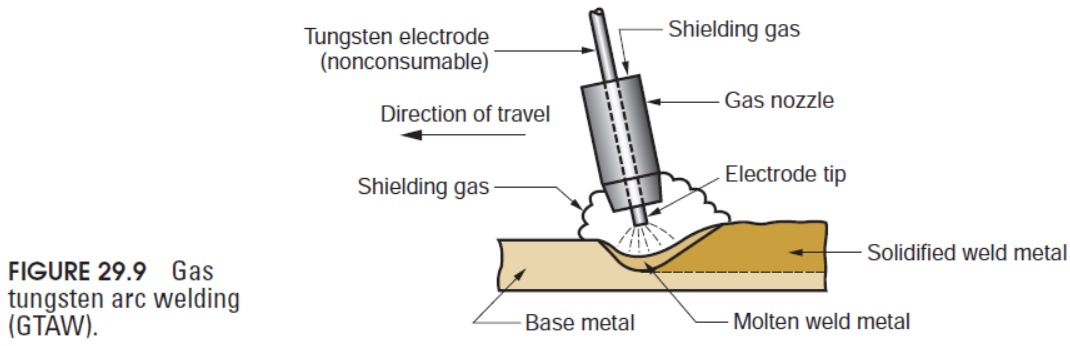
Gas tungsten arc welding (GTAW) is an AW process that uses a nonconsumable tungsten electrode and an inert gas for arc shielding. The term TIG welding (tungsten inert gas welding) is often applied to this process (in Europe, WIG welding is the term—the chemical symbol for tungsten is W, for Wolfram). GTAW can be implemented with or without a fi ller metal. Figure 29.9 illustrates the latter case. When a fi ller metal is used, it is added to the weld pool from a separate rod or wire, being melted by the heat of the arc rather than transferred across the arc as in the consumable electrode AW processes. Tungsten is a good electrode material due to its high melting point of 3410°C (6170°F). Typical shielding gases include argon, helium, or a mixture of these gas elements. GTAW is applicable to nearly all metals in a wide range of stock thicknesses. It can also be used for joining various combinations of dissimilar metals. Its most common
applications are for aluminum and stainless steel. Cast irons, wrought irons, and of course tungsten are diffi cult to weld by GTAW. In steel welding applications, GTAW is generally slower and more costly than the consumable electrode AW processes, except when thin sections are involved and very-high-quality welds are required. When thin sheets are TIG welded to close tolerances, fi ller metal is usually not added. The process can be performed manually or by machine and automated methods for all joint types. Advantages of GTAW in the applications to which it is suited include high-quality welds, no weld spatter because no fi ller metal is transferred across the arc, and little or no postweld cleaning because no fl ux is used.
applications are for aluminum and stainless steel. Cast irons, wrought irons, and of course tungsten are diffi cult to weld by GTAW. In steel welding applications, GTAW is generally slower and more costly than the consumable electrode AW processes, except when thin sections are involved and very-high-quality welds are required. When thin sheets are TIG welded to close tolerances, fi ller metal is usually not added. The process can be performed manually or by machine and automated methods for all joint types. Advantages of GTAW in the applications to which it is suited include high-quality welds, no weld spatter because no fi ller metal is transferred across the arc, and little or no postweld cleaning because no fl ux is used.
[출처: Mikell P. Groover, Fundamentals of Modern Manufacturing Materials, Processes, and Systems]