인베스트먼트 주형
인베스트먼트 주형법(investment molding process).
★ investment casting 인베스먼트 주조
[뜻] 정밀 주조법(精密鑄造法)의 일종. 납 등의 융점이 낮은 것으로 원형(原型)을 만들고 이 주위를 인베스트먼트(내화성이 있는 주형재)로 피복한 후 원형을 융해ㆍ유출시킨 주형을 사용한 주조법
[뜻] 정밀 주조법(精密鑄造法)의 일종. 납 등의 융점이 낮은 것으로 원형(原型)을 만들고 이 주위를 인베스트먼트(내화성이 있는 주형재)로 피복한 후 원형을 융해ㆍ유출시킨 주형을 사용한 주조법
* In investment casting, a pattern made of wax is coated with a refractory material to make the mold, after which the wax is melted away prior to pouring the molten metal. The term investment comes from one of the less familiar defi nitions of the word invest, which is “to cover completely,” this referring to the coating of the refractory material around the wax pattern. It is a precision casting process, because it is capable of making castings of high accuracy and intricate detail. The process dates back to ancient Egypt (Historical Note 11.1) and is also known as the lost-wax process, because the wax pattern is lost from the mold prior to casting.
Steps in investment casting are described in Figure 11.9. Since the wax pattern is melted off after the refractory mold is made, a separate pattern must be made for every casting. Pattern production is usually accomplished by a molding operation—pouring or injecting the hot wax into a master die that has been designed with proper allowances for shrinkage of both wax and subsequent metal casting. In cases where the part geometry is complicated, several separate wax pieces must be joined to make the pattern. In high-production operations, several patterns are attached to a sprue, also made of wax, to form a pattern tree; this is the geometry that will be cast out of metal.
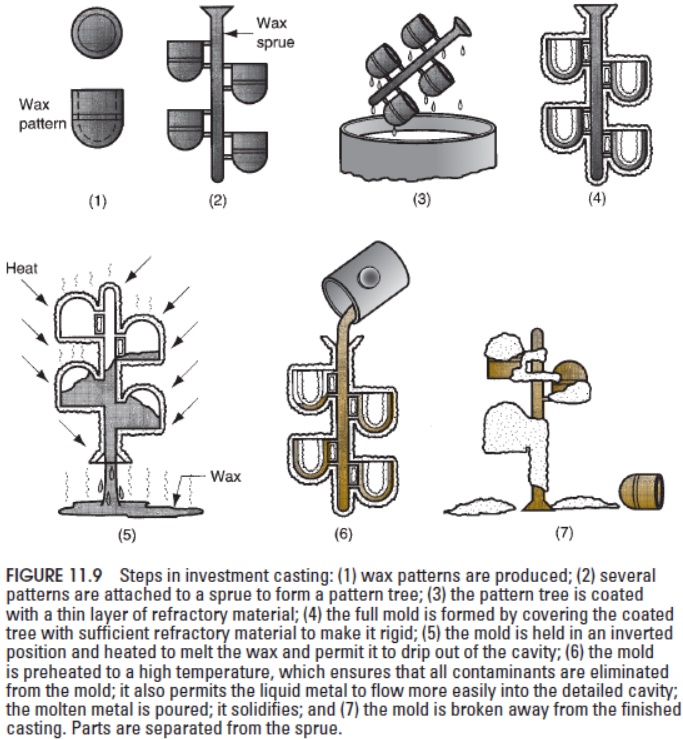
[출처: Mikell P. Groover, Fundamentals of Modern Manufacturing Materials, Processes, and Systems]