사형주조 결함
★ sand casting defects 사형주조 결함.
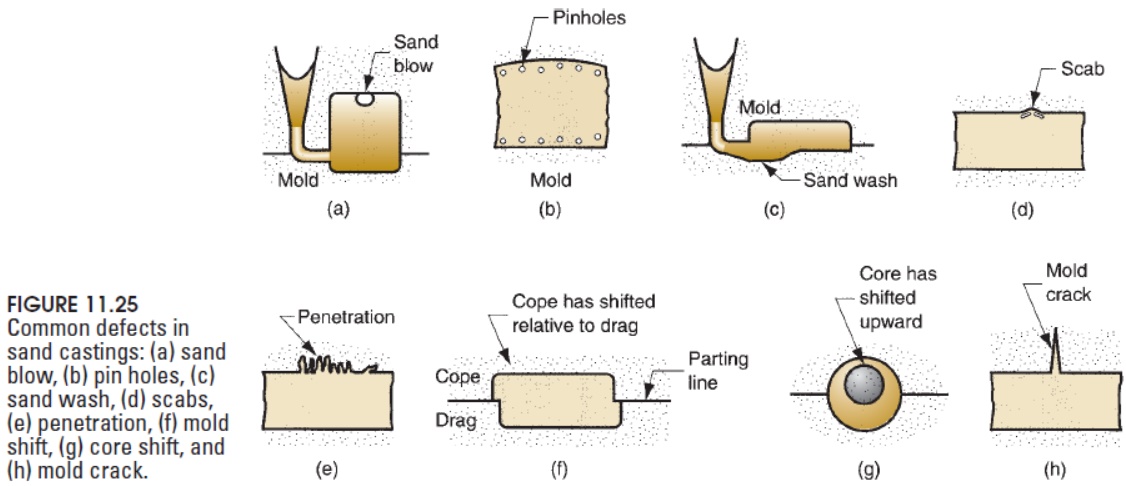
(a) Sand blow is a defect consisting of a balloon-shaped gas cavity caused by release of mold gases during pouring. It occurs at or below the casting surface near the top of the casting. Low permeability, poor venting, and high moisture content of the sand mold are the usual causes.
(b) Pinholes, also caused by release of gases during pouring, consist of many small gas cavities formed at or slightly below the surface of the casting.
(c) Sand wash, which is an irregularity in the surface of the casting that results from erosion of the sand mold during pouring, and the contour of the erosion is formed in the surface of the final cast part.
(d) Scabs are rough areas on the surface of the casting due to encrustations of sand and metal. It is caused by portions of the mold surface flaking off during solidification and becoming imbedded in the casting surface.
(e) Penetration refers to a surface defect that occurs when the fluidity of the liquid metal is high, and it penetrates into the sand mold or sand core. Upon freezing, the casting surface consists of a mixture of sand grains and metal. Harder packing of the sand mold helps to alleviate this condition.
(f) Mold shift refers to a defect caused by a sidewise displacement of the mold cope relative to the drag, the result of which is a step in the cast product at the parting line.
(g) Core shift is similar to mold shift, but it is the core that is displaced, and the displacement is usually vertical. Core shift and mold shift are caused by buoyancy of the molten metal (Section 11.1.3).
(h) Mold crack occurs when mold strength is insufficient, and a crack develops, into which liquid metal can seep to form a “fi n” on the final casting.
[출처: Mikell P. Groover, Fundamentals of Modern Manufacturing Materials, Processes, and Systems]