centerburst
Centerburst. This defect is an internal crack that develops as a result of tensile stresses along the centerline of the work part during extrusion. Although tensile stresses may seem unlikely in a compression process such as extrusion, they tend to occur under conditions that cause large deformation in the regions of the work away from the central axis. The significant material movement in these outer regions stretches the material along the center of the work. If stresses are great enough, bursting occurs. Conditions that promote centerburst are high die angles, low extrusion ratios, and impurities in the work metal that serve as starting points for crack defects. The diffi cult aspect of centerburst is its detection. It is an internal defect that is usually not noticeable by visual observation. Other names sometimes used for this defect include arrowhead fracture, center cracking, and chevron cracking.
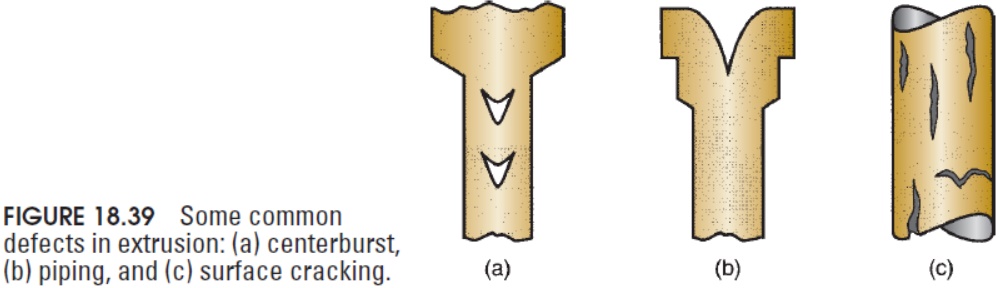
[출처: Mikell P. Groover, Fundamentals of Modern Manufacturing Materials, Processes, and Systems]