전기 슬래그 용접
★ electroslag welding 전기 슬래그 용접, 일렉트로 슬래그 용접.
This process uses the same basic equipment as in some arc welding operations, and it utilizes an arc to initiate welding. However, it is not an AW process because an arc is not used during welding. Electroslag welding (ESW) is a fusion-welding process in which coalescence is achieved by hot, electrically conductive
molten slag acting on the base parts and fi ller metal. As shown in Figure 29.24, the general confi guration of ESW is similar to electrogas welding. It is performed in a vertical orientation (shown here for butt welding), using water-cooled molding shoes to contain the molten slag and weld metal. At the start of the process, granulated conductive fl ux is put into the cavity. The consumable electrode tip is positioned
near the bottom of the cavity, and an arc is generated for a short while to start melting the flux. Once a pool of slag has been created, the arc is extinguished and the current passes from the electrode to the base metal through the conductive slag, so that its electrical resistance generates heat to maintain the welding process. Because the density of the slag is less than that of the molten metal, it remains on top to protect the weld pool. Solidifi cation occurs from the bottom, while additional molten metal is supplied from above by the electrode and the edges of the base parts. The process gradually continues until it reaches the top of the joint.
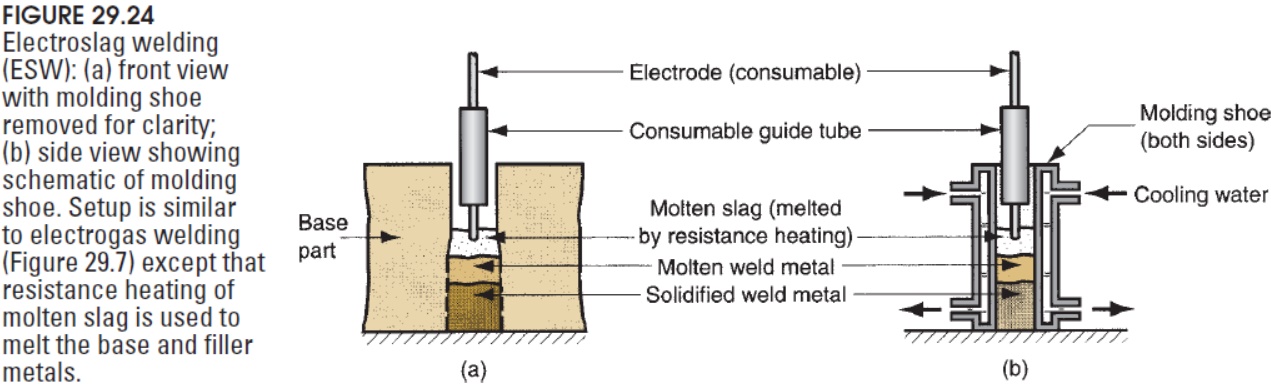
[출처: Mikell P. Groover, Fundamentals of Modern Manufacturing Materials, Processes, and Systems]