웨이브 납땜
★ wave soldering 웨이브 납땜.
Wave soldering is a mechanized technique that allows multiple lead wires to be soldered to a printed circuit board (PCB) as it passes over a wave of molten solder. The typical setup is one in which a PCB, on which electronic components have been placed with their lead wires extending through the holes in the
board, is loaded onto a conveyor for transport through the wave-soldering equipment. The conveyor supports the PCB on its sides, so that its underside is exposed to the processing steps, which consist of the following: (1) fl ux is applied using any of several methods, including foaming, spraying, or brushing; (2) preheating (using light bulbs, heating coils, and infrared devices) to evaporate solvents, activate the
fl ux, and raise the temperature of the assembly; and (3) wave soldering, in which the liquid solder is pumped from a molten bath through a slit onto the bottom of the board to make the soldering connections between the lead wires and the metal circuit on the board. This third step is illustrated in Figure 30.9. The board is often inclined slightly, as depicted in the sketch, and a special tinning oil is mixed with the molten solder to lower its surface tension. Both of these measures help to inhibit buildup of excess solder and formation of “icicles” on the bottom of the board. Wave soldering is widely applied in electronics to produce printed circuit board assemblies (Section 35.3.2).
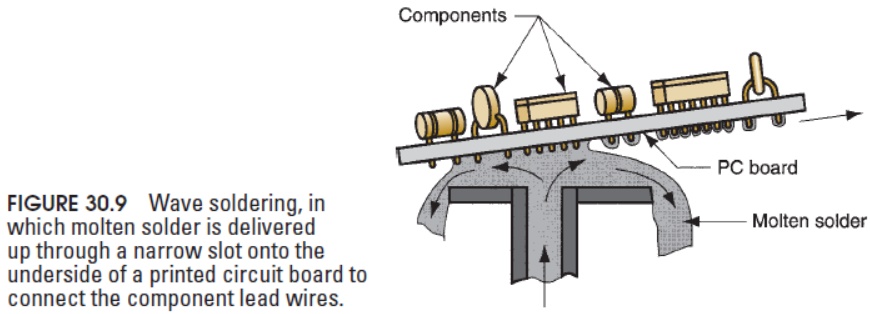
[출처: Mikell P. Groover, Fundamentals of Modern Manufacturing Materials, Processes, and Systems]