쇼클리-리드-홀 재결합
★ Shockley–Read–Hall (SRH) recombination
Recombination through defects, also known as Shockley–Read–Hall (SRH) recombination (Figure 5.6), does not occur in perfectly pure material without defects and is therefore an avoidable recombination;
it can be restricted by reducing the defects. SRH recombination is a two-step process. First, an electron (or hole) is trapped by an energy state in the forbidden region which is introduced through defects in the
crystal lattice, which have been either involuntarily and inadvertently introduced or deliberately added to the material, for example, in doping the material. Second, if a hole (or an electron) moves up to the same
energy state before the electron is thermally reemitted into the conduction band, then it recombines. Thus, it is essentially a process consisting of a conduction-band electron falling to an intermediate level in the forbidden band created by a crystal defect or deep level impurity, and then recombining with hole in the valence band; the energy is liberated as phonons.
The probability of a carrier moving into the energy level in the forbidden gap depends on the distance of the introduced energy level from either of the band edges. Therefore, if an energy level is introduced
close to either band, the likelihood of recombination is less as there are more chances of the electron to be reemitted to the conduction band edge instead of recombining with a hole, which moves into the same
energy state from the valence band. Due to this raison d’être, energy levels near mid-gap are very effective for recombination and are called recombination centers.
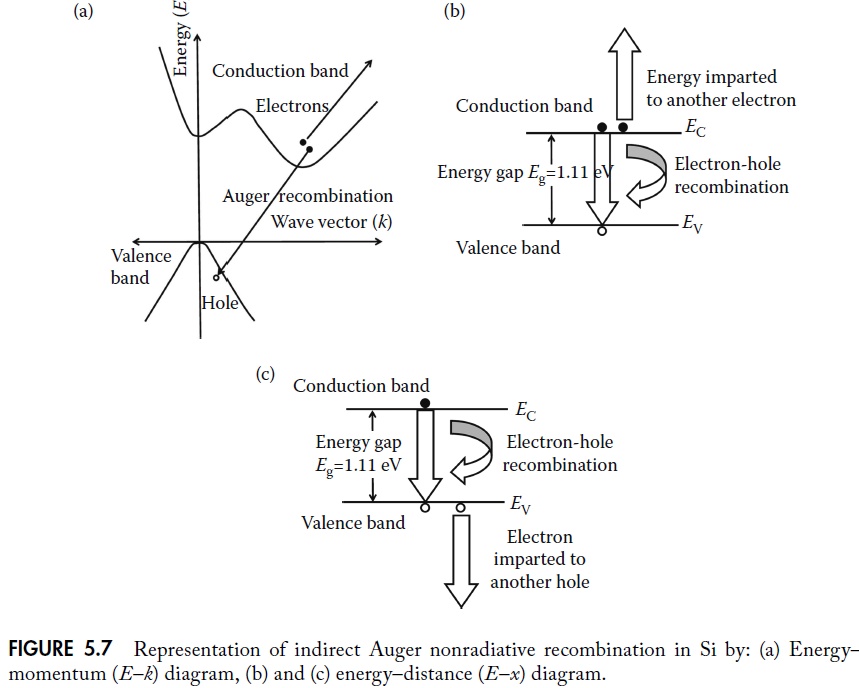
[출처: Vinod Kumar Khanna, Fundamentals of Solid-State Lighting LEDs, OLEDs, and Their Applications in Illumination and Displays]