저취전로법
★ bottom-blown converter process 저취 전로법.
[뜻] 전로 제강법의 일종. 전로의 하부에 설치한 송풍구로부터 노 내의 용선에 공기를 취입하여 강을 취련하는 방법.
The essential feature of bottom-blown steelmaking is that the entire requirement of oxygen (50–55 Nm3 per tonne liquid steel) is introduced through the bottom of the steelmaking vessel using tuyeres, canned porous elements, or refractories with controlled porosity. Sometimes, lime is also introduced along with oxygen, in which case only tuyeres can be employed. The oxygen bottom-blowing process (Figure 3.2) is also known by the name OBM (Oxygen Bottom Maxhuette—Maxhuette was the steel works in Germany where bottom-blowing trials were first undertaken) or Q-BOP (Q standing for Quiescent/Quiet—the state of the bath vis-àvis LD steelmaking) or LWS (Loire, Wendel and Sprunck—the names of three companies in
France who developed this process). In the OBM/Q-BOP process, the oxygen tuyeres are cooled by injecting hydrocarbon gas through an outer pipe surrounding the oxygen pipe. Most bottomblown processes use methane or propane as the hydrocarbon coolant, but fuel oil was employed in LWS converters. A principal advantage of bottom-blowing processes is that they operate closer to equilibrium, encourage early formation of a fluid slag, reduce the oxygen content of the steel tapped, and decrease the height requirements of the converter building since no top lance equipment needs to be provided. Therefore, it became possible to retrofit bottom-blown converters in the existing open hearth shops from the late 1970s with less capital cost in comparison to BOFs.
France who developed this process). In the OBM/Q-BOP process, the oxygen tuyeres are cooled by injecting hydrocarbon gas through an outer pipe surrounding the oxygen pipe. Most bottomblown processes use methane or propane as the hydrocarbon coolant, but fuel oil was employed in LWS converters. A principal advantage of bottom-blowing processes is that they operate closer to equilibrium, encourage early formation of a fluid slag, reduce the oxygen content of the steel tapped, and decrease the height requirements of the converter building since no top lance equipment needs to be provided. Therefore, it became possible to retrofit bottom-blown converters in the existing open hearth shops from the late 1970s with less capital cost in comparison to BOFs.
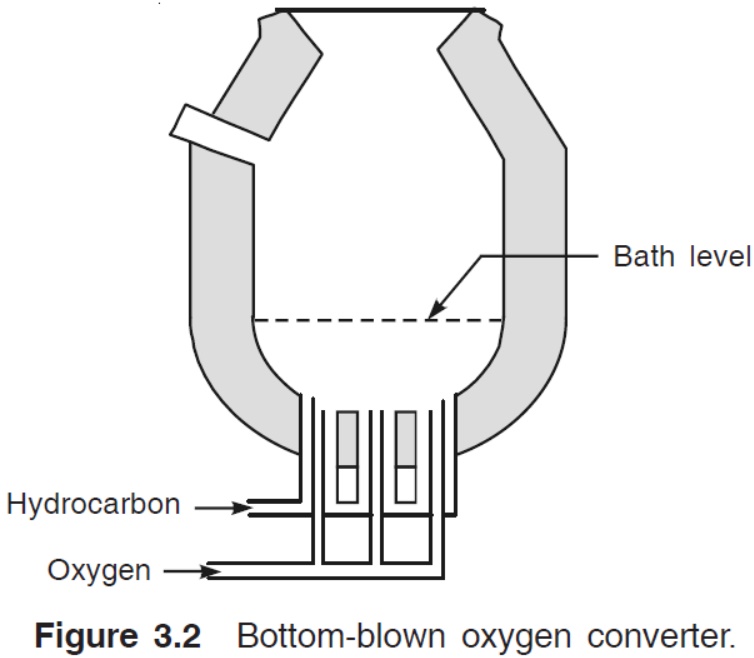
[출처: GHOSH, A. CHATTERJEE, A., IRON MAKING AND STEELMAKING THEORY AND PRACTICE]