잉곳 몰드
★ ingot mold (= ingot case) 잉곳 몰드.
[뜻] 제강로에서 정련을 마친 용강을 강괴로 만들기 위해 이용하는 주형.
Figure 22.1 depicts three common types of ingot moulds, viz. narrow-end-up, wide-end-up, and wide-end-up with hot top. An important issue is the stripping of the solidified ingot from the mould. Cast iron moulds have an advantage since the coefficient of thermal expansion of cast iron is different from that of steel. Upon cooling, steel contracts more than the cast iron mould, which assists detachment. The conical shape of the moulds facilitates pulling-out of only the mould by a stripping crane, thus separating the mould from the solidified ingot. In this context, the narrow-end-up mould is the most convenient. In addition, the inner walls of the mould are coated with tar, pitch or similar materials at a temperature of about 150–250°C. When the tar or pitch decomposes at high temperature, fine carbon is formed on the mould surface, which prevents sticking of the solidified ingot with the mould. In case the mould is cold, pre-heating is required.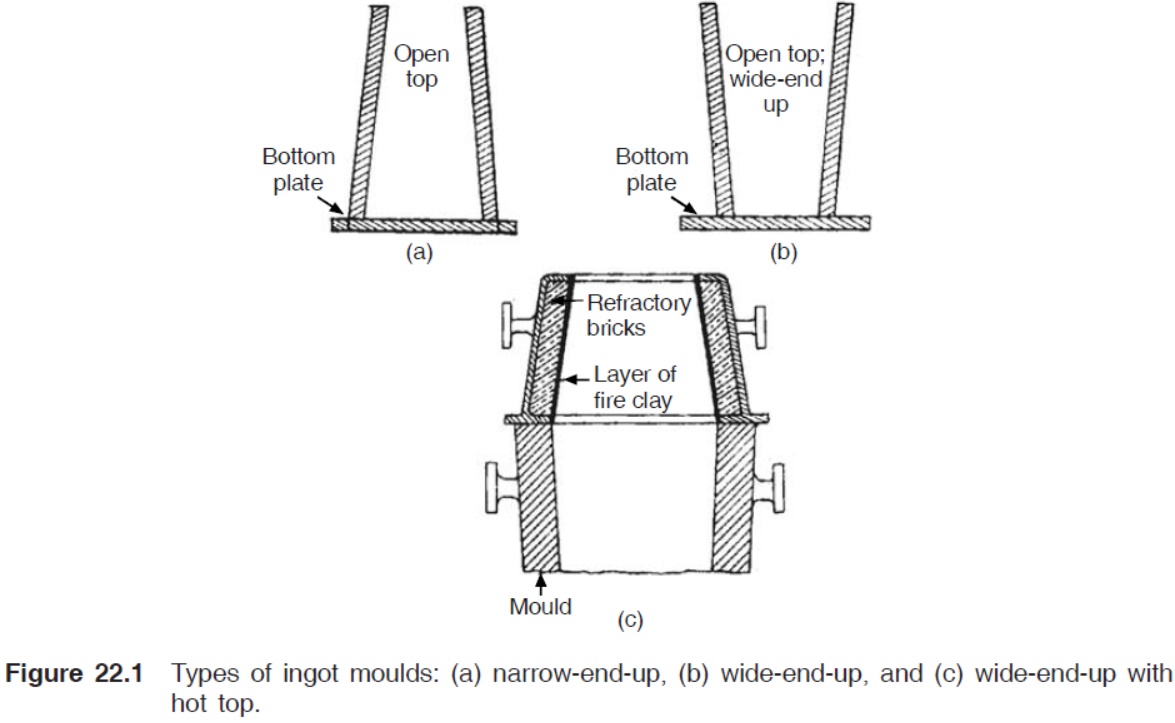
[출처: GHOSH, A. CHATTERJEE, A., IRON MAKING AND STEELMAKING THEORY AND PRACTICE]