역충전
★ reverse charging [배터리] 역충전.
"역충전(reverse charging)"이란 방전된 배터리에 있어 정상적인 전류의 흐름과 같은 방향으로 1차전지 또는 2차전지에 강제적으로 전류를 흘리는 것을 말한다.
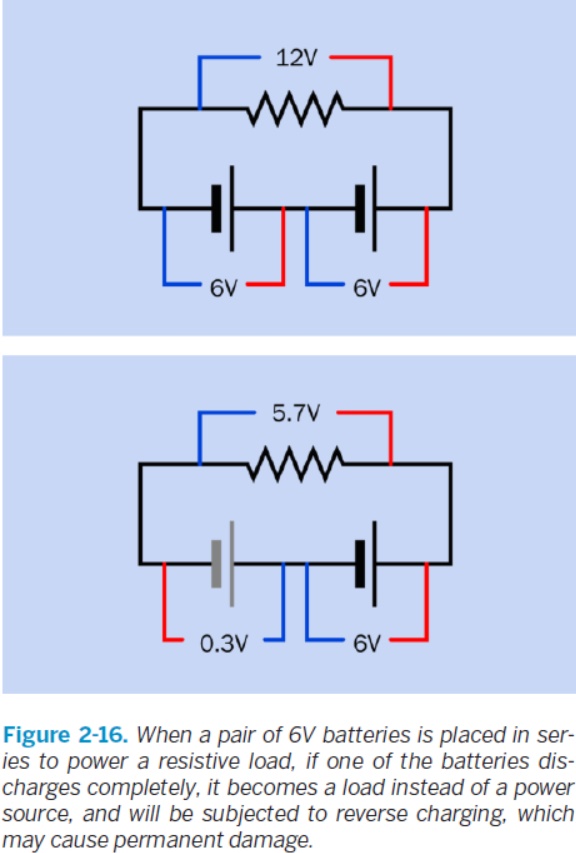
Reverse charging can occur when a battery becomes completely discharged while it is wired (correctly) in series with other batteries that are still delivering current. In the upper section of the schematic at Figure 2-16 two healthy 6V batteries, in series, are powering a resistive load. The battery on the left applies a potential of 6 volts to the battery on the right, which adds its own 6 volts to create a full 12 volts across the load. The red and blue lines indicate volt meter leads, and the numbers show the reading that should be
observed on the meter.
In the second schematic, the battery on the left has become exhausted and is now a “dead weight” in the circuit, indicated by its gray color. The battery on the right still sustains a 6-volt potential. If the internal resistance of the dead battery is approximately 1 ohm and the resistance of the load is approximately 20 ohms, the potential across the dead battery will be about 0.3 volts, in the opposite direction to its normal charged voltage. Reverse charging will result and can damage the battery. To avoid this problem, a battery pack containing multiple cells should never be fully discharged.
[출처: Charles Platt, Encyclopedia of Electronic Components Volume 1 Resistors, Capacitors, Inductors, Switches, Encoders, Relays, Transistors]