투과형 광학 센서
★ transmissive optical sensor 투과형 광학 센서.
* A transmissive optical sensor, also known as a through-beam sensor, is really a pair of components,
one emitting light and the other receiving it. The sensor is triggered if an object interrupts or reflects the light beam, as shown in Figure 3-3. If the light emitter and the light detector face each other across a small gap, they may be contained in a single module (usually with a slot in it) as shown in section 2 of Figure 3-3. This is often referred to as an optical switch (not to be confused with the solid-state switching devices
used in telecommunications). It is sometimes described as a photointerruptor or photointerrupter.
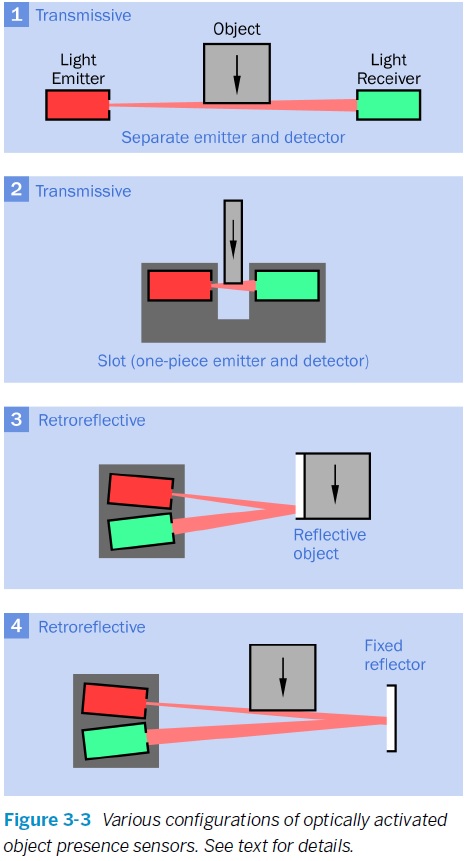
[출처: Encyclopedia of Electronic Components Volume 3 Sensors for Location, Presence, Proximity, Orientation, Oscillation, Force, Load, Human Input, Liquid ... Light, Heat, Sound, and Electricity]