스냅 끼워맞춤
★ snap fit
Snap fits are a variation of interference fi ts. A snap fit involves joining two parts in which the mating elements possess a temporary interference while being pressed together, but once assembled they interlock to maintain the assembly. A typical example is shown in Figure 31.13: as the parts are pressed together, the mating elements elastically deform to accommodate the interference, subsequently allowing the parts to snap together; once in position, the elements become connected mechanically so that they cannot easily be disassembled. The parts are usually designed so that a slight interference exists after assembly.
Advantages of snap fi t assembly include (1) the parts can be designed with selfaligning features, (2) no special tooling is required, and (3) assembly can be accomplished very quickly. Snap fi tting was originally conceived as a method that would be ideally suited to industrial robotics applications; however, it is no surprise that assembly techniques that are easier for robots are also easier for human assembly workers.
Advantages of snap fi t assembly include (1) the parts can be designed with selfaligning features, (2) no special tooling is required, and (3) assembly can be accomplished very quickly. Snap fi tting was originally conceived as a method that would be ideally suited to industrial robotics applications; however, it is no surprise that assembly techniques that are easier for robots are also easier for human assembly workers.
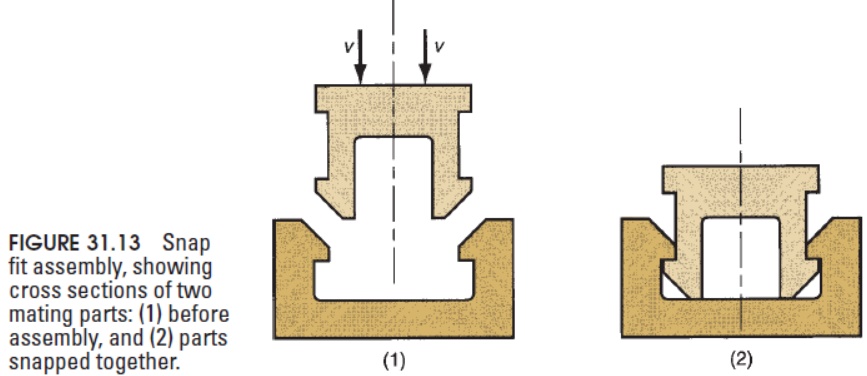
[출처: Mikell P. Groover, Fundamentals of Modern Manufacturing Materials, Processes, and Systems]