스테레오리소그래피
★ sterolithography
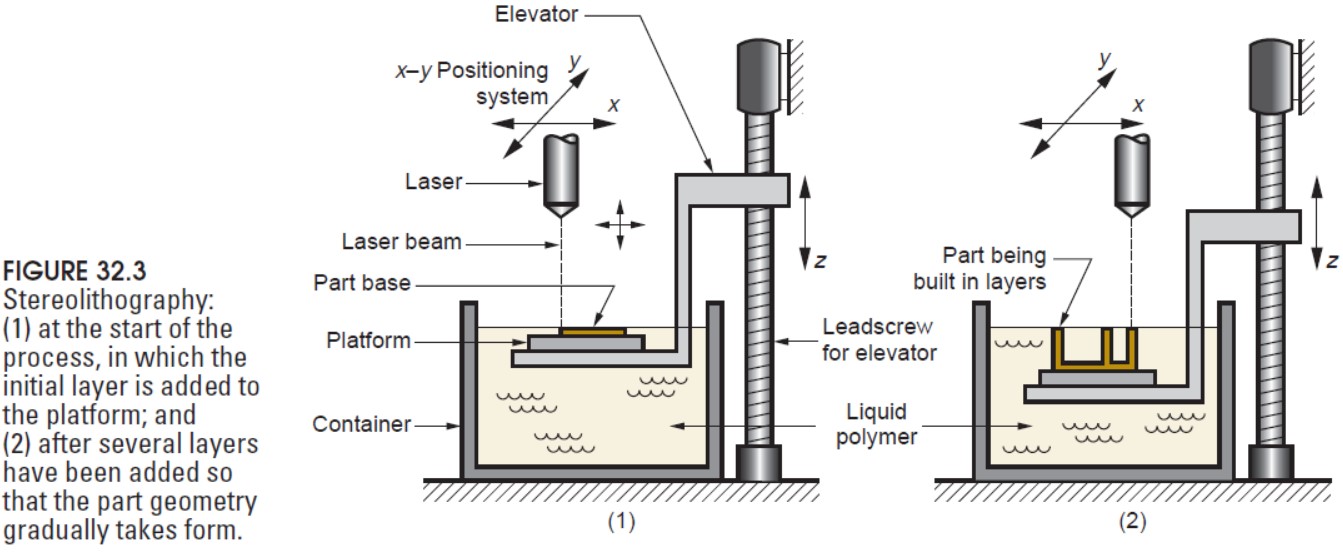
This was the fi rst material addition RP technology, dating from about 1988 and introduced by 3D Systems Inc. based on the work of inventor Charles Hull. It is one of the most widely used additive manufacturing methods. Stereolithography (SL) is a process for fabricating a solid plastic part out of a photosensitive liquid polymer using a directed laser beam to solidify the polymer. The general setup for the process is illustrated in Figure 32.3. Part fabrication is accomplished as a series of layers, in which one layer is added onto the previous layer to gradually build the desired three-dimensional geometry. A part fabricated
by SL is illustrated in Figure 32.4.
The stereolithography apparatus consists of (1) a platform that can be moved vertically inside a vessel containing the photosensitive polymer, and (2) a laser whose beam can be controlled in the x-y direction. At the start of the process, the platform is positioned vertically near the surface of the liquid photopolymer, and the laser beam is directed through a curing path that comprises an area corresponding
to the base (bottom layer) of the part. This and subsequent curing paths are defi ned by the STI fi le (step 3 in preparing the control instructions described earlier). The action of the laser is to harden (cure) the photosensitive polymer where the beam strikes the liquid, forming a solid layer of plastic that adheres to the platform. When the initial layer is completed, the platform is lowered by a distance equal to the layer thickness, and a second layer is formed on top of the first by the laser, and so on. Before each new layer is cured, a recoating blade is passed over the viscous liquid resin to ensure that its level is the same throughout the surface.
Each layer consists of its own area shape, so that the succession of layers, one on top of the previous, creates the solid part shape. Typical layer thickness is 0.05 to 0.15 mm (0.002–0.006 in). Thinner layers provide better resolution and allow more intricate part shapes; but processing times are longer. Typical liquid photopolymers include acrylic and epoxy, which are cured upon exposure to an ultraviolet laser.
After all of the layers have been formed, excess polymer is removed, and light sanding is sometimes used to improve smoothness and appearance.
[출처: Mikell P. Groover, Fundamentals of Modern Manufacturing Materials, Processes, and Systems]