스테인레스강
★ stainless steel 스테인레스강.
* ferritic stainless steel 페라이트계 스테인리스강.
* stainless steel alloy 스테인레스강 합금.
* stainless steel plate 스테인레스 강판.
* stainless steel sheet 스테인레스 강판.
* stainless steel substrate 스테인레스강 기판.
* stainless steel rod 스테인레스강 봉.
* stainless steel fiber 스테인레스강 섬유.
* stainless steel wire 스테인레스강 선재.
* stainless steel welding unit 스테인레스강 용접부.
* Stainless steels are a group of highly alloyed steels designed to provide high corrosion resistance. The principal alloying element in stainless steel is chromium, usually above 15%. The chromium in the alloy forms a thin, impervious oxide fi lm in an oxidizing atmosphere, which protects the surface from corrosion.
Nickel is another alloying ingredient used in certain stainless steels to increase corrosion protection. Carbon is used to strengthen and harden the metal; however, increasing the carbon content has the effect of reducing corrosion protection because chromium carbide forms to reduce the amount of free Cr available in the alloy. In addition to corrosion resistance, stainless steels are noted for their combination
of strength and ductility. Although these properties are desirable in many applications, they generally make these alloys diffi cult to work in manufacturing. Also, stainless steels are signifi cantly more expensive than plain C or low alloy steels. Stainless steels are traditionally divided into three groups, named for the predominant phase present in the alloy at ambient temperature:
1. Austenitic stainless steels have a typical composition of around 18% Cr and 8% Ni and are the most corrosion resistant of the three groups. Owing to this composition, they are sometimes identifi ed as 18-8 stainless. They are nonmagnetic and very ductile; but they show signifi cant work hardening. The nickel has the effect of enlarging the austenite region in the iron–carbon phase diagram, making it stable at room temperature. Austenitic stainless steels are used to fabricate chemical and food processing equipment, as well as machinery parts requiring high corrosion resistance.
2. Ferritic stainless steels have around 15% to 20% chromium, low carbon, and no nickel. This provides a ferrite phase at room temperature. Ferritic stainless steels are magnetic and are less ductile and corrosion resistant than the austenitics. Parts made of ferritic stainless range from kitchen utensils to jet
engine components.
3. Martensitic stainless steels have a higher carbon content than ferritic stainlesses, thus permitting them to be strengthened by heat treatment (Section 26.2). They have as much as 18% Cr but no Ni. They are strong, hard, and fatigue resistant, but not generally as corrosion resistant as the other two groups. Typical products include cutlery and surgical instruments.
[출처: Mikell P. Groover, Fundamentals of Modern Manufacturing Materials, Processes, and Systems]
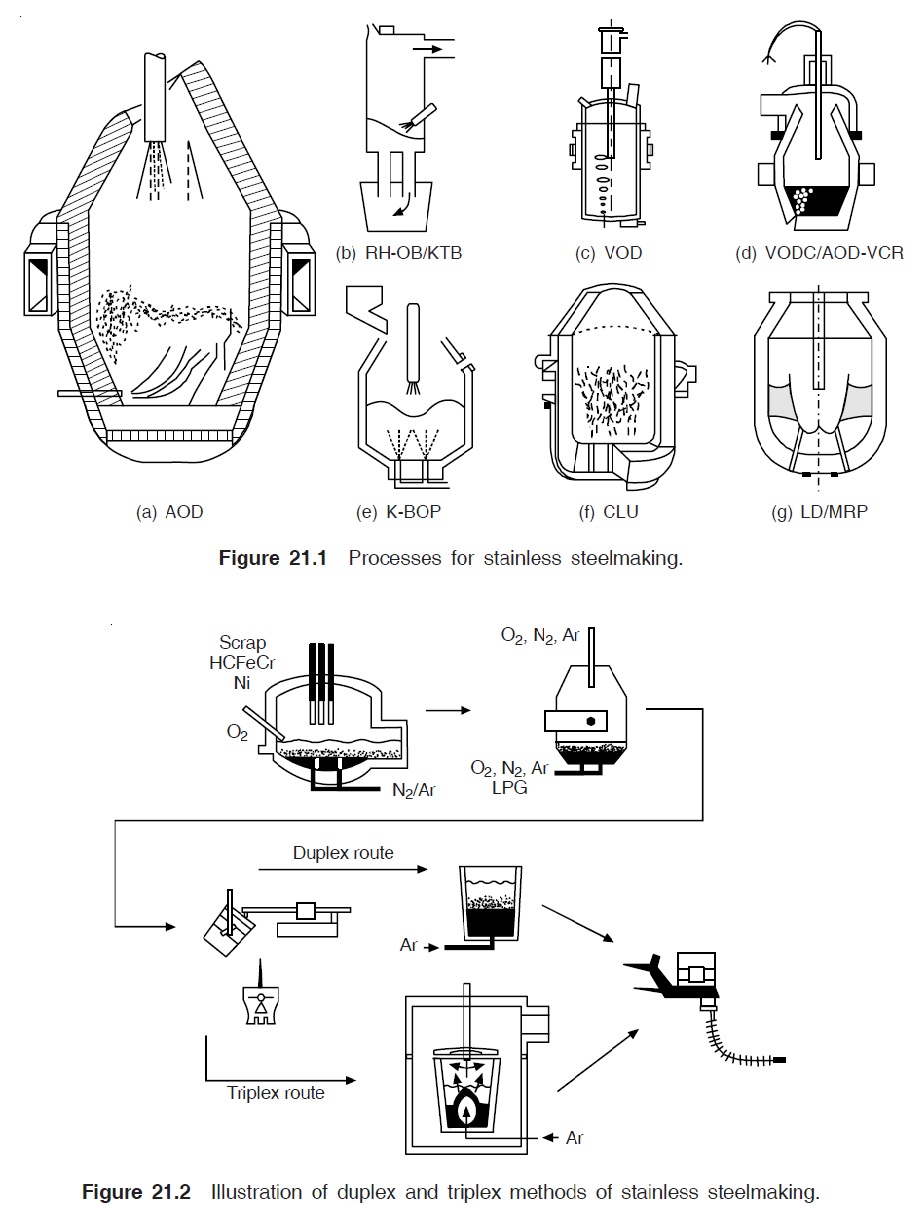
[출처: GHOSH, A. CHATTERJEE, A., IRON MAKING AND STEELMAKING THEORY AND PRACTICE]