스텝퍼 모터
★ stepper motor 스텝퍼 모터.
Also often referred to as a stepping motor, and sometimes known as a step motor. It is a type of induction motor but merits its own entry in this encyclopedia as it has acquired significant and unique importance in electronics equipment where precise positioning of a moving part is needed and digital control is available.
A stepper motor rotates its drive shaft in precise steps in response to a timed sequence of pulses (usually one step per pulse). The pulses are delivered to a series of coils or windings in the stator, which is the stationary section of the motor, usually forming a ring around the rotor, which is the part of the motor that rotates. Steps may also be referred to as phases, and a motor that rotates in small steps may be referred to as having a high phase count. A stepper motor theoretically draws power for its stator coils at a constant level that does not vary with speed. Consequently the torque tends to decrease as the speed increases, and conversely, it is greatest when the motor is stationary or locked. The motor requires a suitable control system to provide the sequence of pulses. The control system may consist of a small dedicated circuit, or a
microcontroller or computer with the addition of suitable driver transistors capable of handling the necessary current. The torque curve of a motor can be extended by using a controller that increases the voltage as the speed of the control pulses increases. Because the behavior of the motor is controlled
by external electronics, and its interior is usually symmetrical, a stepper motor can be driven backward
and forward with equal torque, and can also be held in a stationary position, although the stator coils will continue to consume power in this mode.
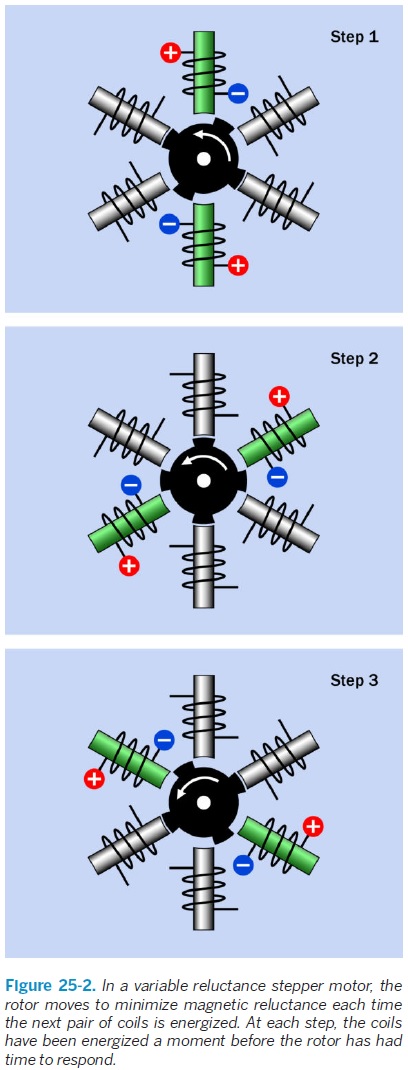
[출처: Charles Platt, Encyclopedia of Electronic Components Volume 1 Resistors, Capacitors, Inductors, Switches, Encoders, Relays, Transistors]