스퍼터링
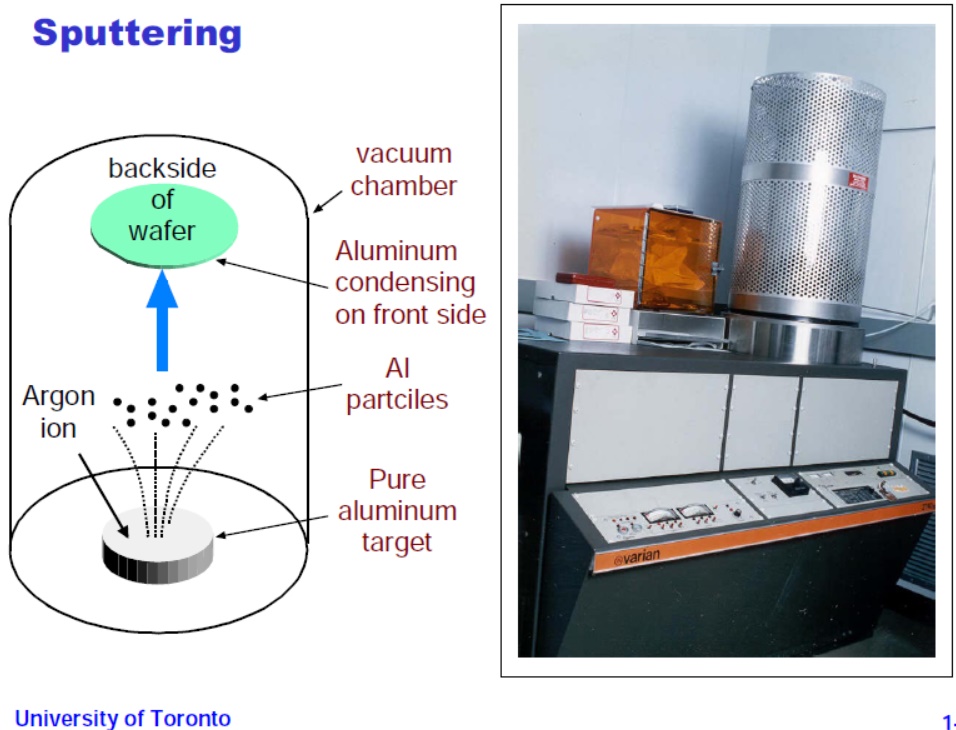
★ sputtering 스퍼터링.
* If the surface of a solid (or liquid) is bombarded by atomic particles of sufficiently high energy, individual atoms of the surface may acquire enough energy due to the collision that they are ejected from the surface by transfer of momentum. This is the process known as sputtering. The most convenient form of high energy particle is an ionized gas, such as argon, energized by means of an electric field to form a plasma.
|
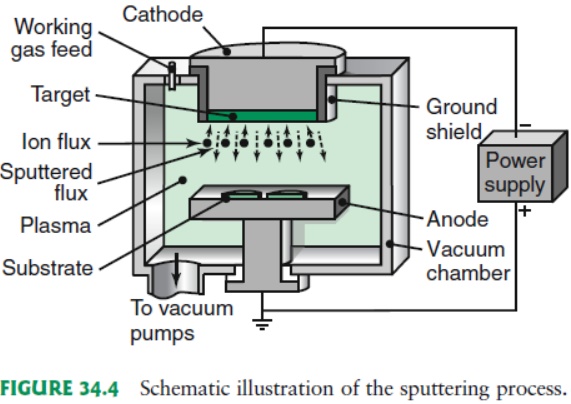
In sputtering, an electric field ionizes an inert gas (usually argon). The positive ions bombard the coating material (cathode) and cause sputtering (ejection) of its atoms. The atoms then condense on the workpiece, which is heated to improve bonding (Fig. 34.4). In reactive sputtering, the inert gas is replaced by a reactive gas (such as oxygen), in which case the atoms are oxidized and the oxides are deposited. Carbides and nitrides also are deposited by reactive sputtering. Alternatively, very thin polymer coatings can be deposited on metal and polymeric substrates with a reactive gas, causing polymerization of the plasma. Radio-frequency (RF) sputtering is used for nonconductive materials, such as electrical insulators and semiconductor devices. [Source: Serope Kalpakjian, Steven R. Schmid, Manufacturing Engineering and Technology] |
[Source: Serope Kalpakjian, Steven R. Schmid, Manufacturing Engineering and Technology]