스펀본드 부직포
★ spunbonded fabric
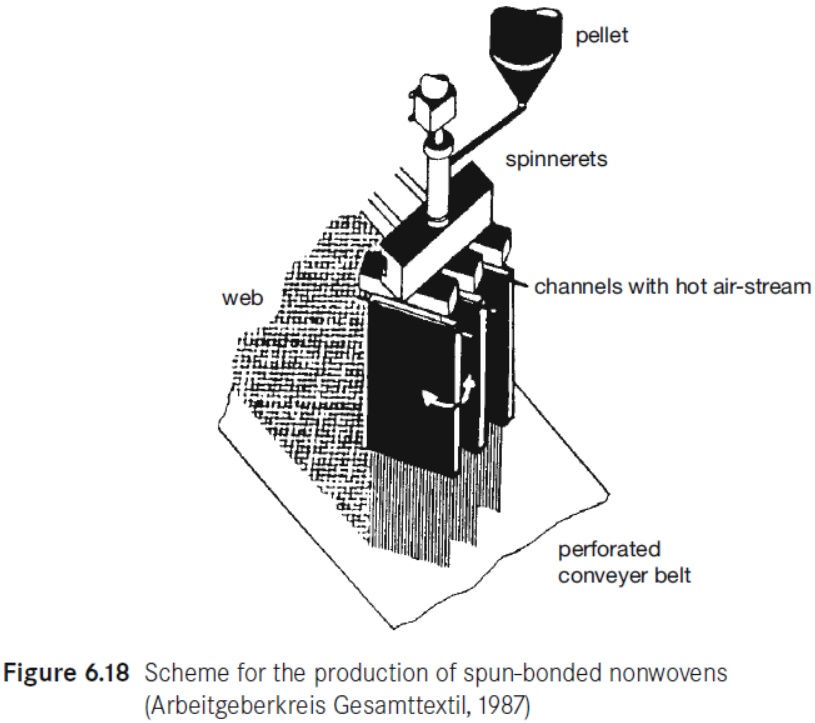
The production of filaments corresponds to traditional fiber production. The less common wet-spinning process and the more important melt-spinning process are used for this. Synthetic pellets are melted and delivered to the spinneret. The spun fibers are then pulled off aerodynamically or mechanically and then simultaneously drafted. The formed filaments are supplied directly to the web folding, which consists of a sieve-like collection device. The accompanying air can be sucked off through this “sieve.” The filaments are deposited almost in circular curves because of a collection delivery speed that is 1 to 2% below the filament delivery speed. As a consequence, the threads have no prevalent direction. This justifies the name
“randomly oriented nonwoven.” At very high production speeds (such as for hygienic products) the fibers may become oriented in one direction, however. In this way, a web develops that has nearly identical physical characteristics in all geometrical directions and therefore it is “isotropic.” No other textile fabric forming process can achieve this. Figure 6.18 presents a scheme for the production of spun-bonded
nonwovens.
[출처: Thomas Gries et al., Textile Technology, 2nd Ed., HANSER]
★ spunlaid fabric