아세테이트 섬유
★ acetate fiber 아세테이트 섬유.
The raw material for the production of acetate fibers is also cellulose, but acetate fibers are not regenerated cellulose fibers; they are composed of cellulose derivate (cellulosic ester) instead.
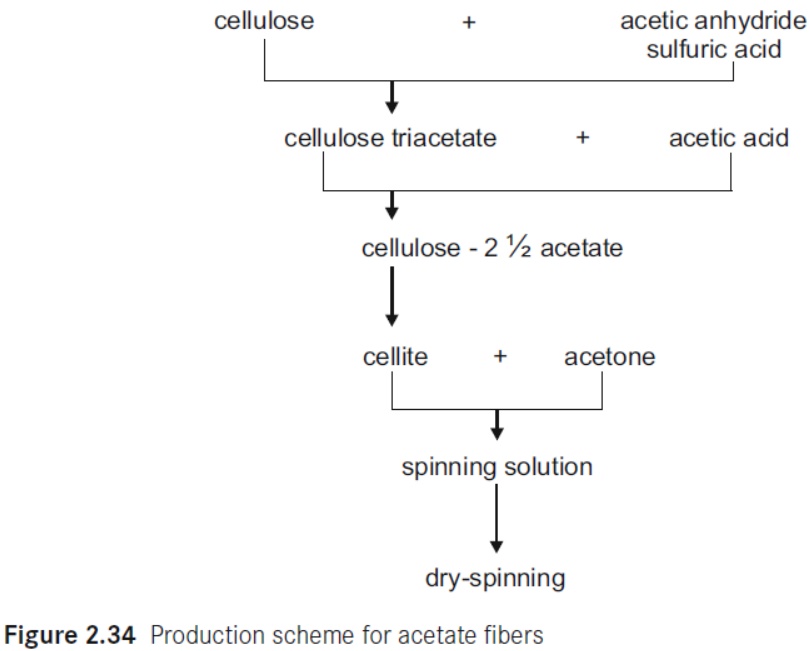
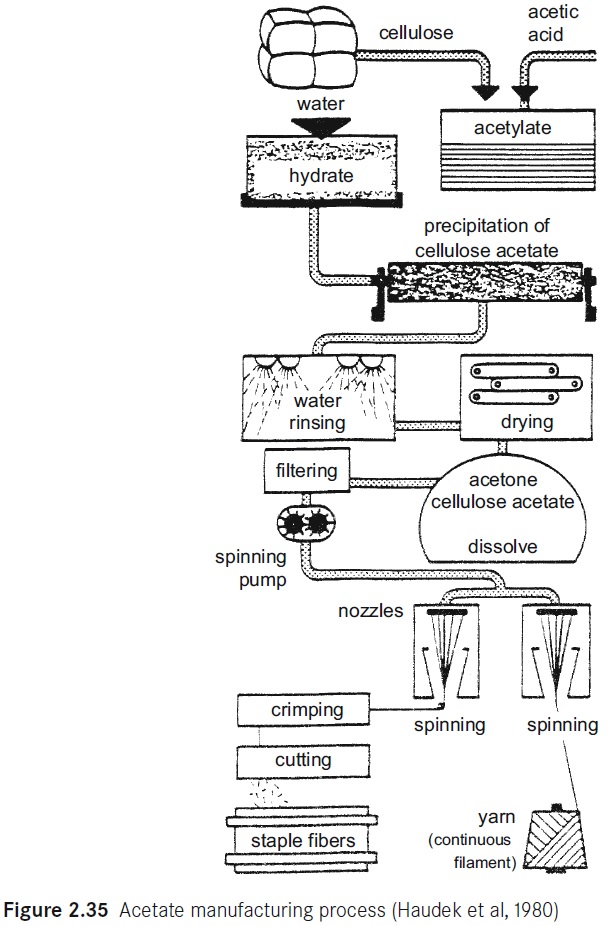
The cellulose as bleached cotton linters or alpha pulp is mixed with acetic anhydride and glacial acetic acid under addition of water-splitting chemicals (sulfuric acid works as a catalyst). This results in a highly viscous solution, the cellulose triacetate (also primary acetate), which contains acetic acid. Further exposure of this solution to dilute sulfuric and acetic acid causes a partial saponification (hydrating or “maturing”) of the primary acetate that is difficult to spin. This results in secondary acetate, also called 2½ acetate. The production scheme for acetate is shown in Fig. 2.34, and the spinning process for acetate is explained in Fig. 2.35.
The cellulose as bleached cotton linters or alpha pulp is mixed with acetic anhydride and glacial acetic acid under addition of water-splitting chemicals (sulfuric acid works as a catalyst). This results in a highly viscous solution, the cellulose triacetate (also primary acetate), which contains acetic acid. Further exposure of this solution to dilute sulfuric and acetic acid causes a partial saponification (hydrating or “maturing”) of the primary acetate that is difficult to spin. This results in secondary acetate, also called 2½ acetate. The production scheme for acetate is shown in Fig. 2.34, and the spinning process for acetate is explained in Fig. 2.35.
[출처: Thomas Gries et al., Textile Technology, 2nd Ed., HANSER]