분리출원
★ separational application 분리출원.
split-off application (?) post-appeal divisional application (?) separated application (?) [특허]
[내용] 특허거절결정에 대한 심판의 청구가 기각된 후에도 일정 범위 내에서 거절결정에 포함되지 않은 청구항을 분리하여 출원을 할 수 있도록 분리출원제도를 도입하여 출원인이 특허받을 수 있는 기회를 확대. 특허는 현재 거절결정불복심판이 진행되면 일부가 등록가능해도 특허 전체가 거절되어 등록가능한 청구항이 있더라도 특허를 받을 수 없었다. 그러나 개정안에서는 심판에서 거절결정이 유지(기각심결)되더라도 등록가능한 청구항만을 구분하여 출원하는 분리출원 제도를 새롭게 도입해 출원인의 권리획득 기회를 확대했다.청구 범위의 경우 분할출원은 원출원의 전체 범위 내에서, 분리출원은 거절결정되지 않은 청구항을 대상으로 한다. (2021.09.30 개정안)
특허법 제52조의2(분리출원) ① 특허거절결정을 받은 자는 제132조의17에 따른 심판청구가 기각된 경우 그 심결의 등본을 송달받은 날부터 30일(제186조제5항에 따라 심판장이 부가기간을 정한 경우에는 그 기간을 말한다) 이내에 그 특허출원의 출원서에 최초로 첨부된 명세서 또는 도면에 기재된 사항의 범위에서 그 특허출원의 일부를 새로운 특허출원으로 분리할 수 있다. 이 경우 새로운 특허출원의 청구범위에는 다음 각 호의 어느 하나에 해당하는 청구항만을 적을 수 있다.
1. 그 심판청구의 대상이 되는 특허거절결정에서 거절되지 아니한 청구항
2. 거절된 청구항에서 그 특허거절결정의 기초가 된 선택적 기재사항을 삭제한 청구항
3. 제1호 또는 제2호에 따른 청구항을 제47조제3항 각 호(같은 항 제4호는 제외한다)의 어느 하나에 해당하도록 적은 청구항
4. 제1호부터 제3호까지 중 어느 하나의 청구항에서 그 특허출원의 출원서에 최초로 첨부된 명세서 또는 도면에 기재된 사항의 범위를 벗어난 부분을 삭제한 청구항
② 제1항에 따라 분리된 특허출원(이하 “분리출원”이라 한다)에 관하여는 제52조제2항부터 제5항까지의 규정을 준용한다. 이 경우 “분할”은 “분리”로, “분할출원”은 “분리출원”으로 본다.
③ 분리출원을 하는 경우에는 제42조의2제1항 후단 또는 제42조의3제1항에도 불구하고 특허출원서에 최초로 첨부한 명세서에 청구범위를 적지 아니하거나 명세서 및 도면(도면 중 설명부분에 한정한다)을 국어가 아닌 언어로 적을 수 없다.
④ 분리출원은 새로운 분리출원, 분할출원 또는 「실용신안법」 제10조에 따른 변경출원의 기초가 될 수 없다.
[본조신설 2021. 10. 19.]
Article 52-2 (Splitting-Off)
(1) A person who has received a decision to reject a patent application may split off part of the application into a new patent application within the scope of the features described in the specification or drawings accompanying the initial patent application within 30 days (referring to the period prescribed by the presiding judge, if the period is specified in Article 186 (5)) from the date a certified copy of the trial ruling is received, if his or her filing of a petition for trial under Article 132-17 is dismissed. In such cases, any of the following claims a new patent application may contain any of the following claims:
1.
A claim that has not been rejected in the decision to reject the patent application, which is the subject matter of the petition for trial;
2.
A claim that deletes the extra descriptions in the rejected claims based on which the decision to reject the patent application has been made;
3.
A description of the claims under subparagraph 1 or 2 as ones falling under any subparagraph of Article 47 (3) (excluding subparagraph 4 of the same paragraph);
4.
A claim that deletes the part of the descriptions entered in the specification or drawings initially accompanying the patent application from any claim falling under any of subparagraphs 1 through 3.
(2)
Article 52 (2) through (5) shall apply mutatis mutandis to patent applications split off under paragraph (1) (hereinafter referred to as "splitting-off"). In such cases, "division" shall be construed as "splitting-off", and "divisional application" shall be construed as "splitting-off."
(3)
Notwithstanding the latter part of Article 42-2 (1) or Article 42-3 (1), in cases of a splitting-off, the claims shall be contained in the specification accompanying the initial patent application or the specification and drawings (limited to the captions in drawings) shall be in Korean.
(4)
A splitting-off shall not form the basis of a new splitting-off, a divisional application, or a converted application under Article 10 of the Utility Model Act.
[This Article Newly Inserted on Oct. 19, 2021]
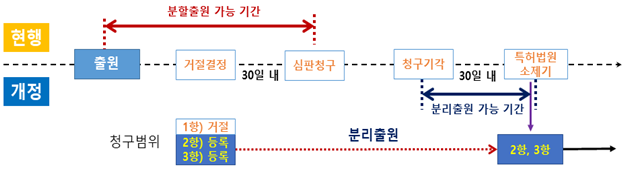
[분할출원(현행)과 분리출원(개정안 포함)을 비교한 도식화 자료. 특허청 제공]
* New "separate applications" for non-rejected patent claims introduced
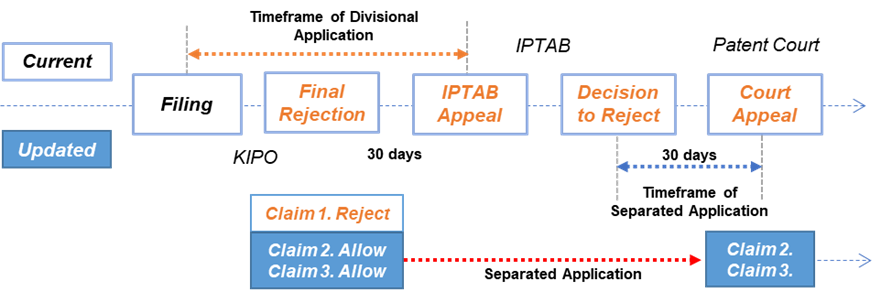
Under the current system, an applicant seeking to appeal a final rejection commonly also will file a divisional application to maintain the ability to continue prosecution if the appeal is dismissed or withdrawn, since the applicant only has a limited time after the final rejection to file such a divisional.
The amended KPA introduces the concept of a new "separate application" that may allow the applicant to preserve some patent rights in the application after an unsuccessful appeal of a final rejection, even if for some reason a divisional application was not filed. Under the amended KPA, if an appeal is dismissed, the applicant can file a "separate application" within 30 days for any patent claims that were pending in the application but not rejected in the final rejection. However, a separate application cannot be filed if all of the claims of the application were rejected, and further divisional/separate applications cannot be filed from a separate application, limiting the utility of such applications. Given such limitations of separate applications, filing a divisional application as a placeholder is still an important strategic option if the applicant chooses to file an appeal with the Intellectual Property Trial and Appeal Board (IPTAB) against a final rejection.
* It has been the case that the decision of rejection is rendered against the entirety of a patent application even in case where only parts of claims contained matters subject to rejection and the remainder of claims are allowable. Under the Patent Act currently in effect, there was no way to obtain patent even for parts of claims that have been determined to be allowable by the examiner in case the appeal is dismissed after the decision of rejection is appealed because it is impossible to submit an amendment or file a divisional application once appealed. In the Revised Act, a new divisional application scheme has been introduced to enable filing of a divisional application by separating allowable claims even if the decision of rejection is maintained at the appeal (the decision to dismiss the appeal).
Requirements for subject matter
A separated application is allowed within the scope of the original disclosure of the parent application. The claims are limited to any one of the following (Article 52bis(1)):
- A claim which was not rejected in the final rejection subject to appeal;
- A claim which is drafted by removing from a rejected claim the selective features on which the final rejection was based;
- A claim of item 1 or 2, which is drafted by narrowing the claim, correcting a clerical error(s), or clarifying an unclear description(s); and
- A claim of any one of items 1 to 3, which is drafted by deleting subject matter which goes beyond the original disclosure of the parent application.
Requirements for formalities
The separated application (specification and drawings) cannot be filed in English, and the claims must be submitted at the time of filing (Article 52bis(3)). The applicant(s) must be the same as those of the parent application.
Effective filing date
Like a divisional application, a separated application benefits from the same filing date of the parent application, and can also enjoy the priority benefits of the parent application (Article 52bis(2)).
Prosecution/grant
Like a divisional application, a request for examination can be filed within 30 days of the date of filing a separated application (Article 59(3)). It is possible to obtain a patent rapidly since only the allowable portions of the claims are separated from the parent application.
Violating the requirements for subject matter according to Article 52bis(1) will be grounds for rejection, grounds for third-party observation, and grounds for invalidation.
Limitation
A separated application is not allowed to use an option to file a request for re-examination along with an amendment when a notice of allowance or a notice of final rejection is issued (Article 67bis(1)); thus, it has fewer opportunities to file an amendment compared to a divisional application.
Further, separated applications are banned from further continuing the application since they cannot be a basis for filing a next generation of divisional or separated applications, or filing a conversion between patent and utility model applications (Article 52bis(4)).