연소분석
★ combustion analysis [화학] 연소 분석.
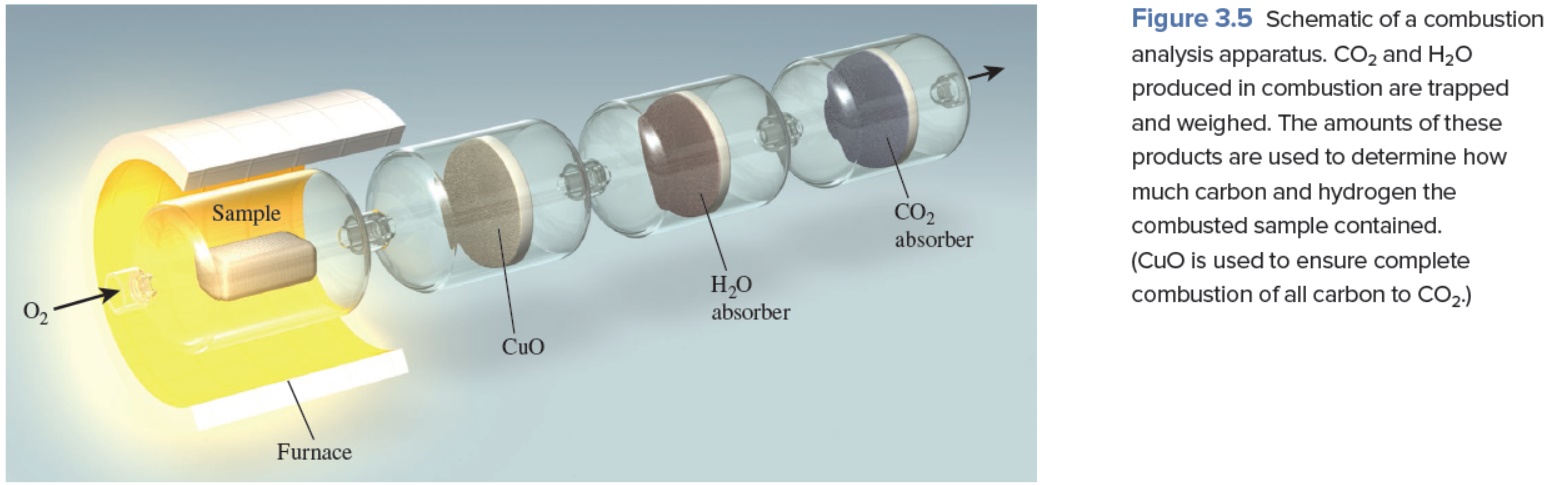
* Combustion analysis of organic compounds (containing carbon, hydrogen, and sometimes oxygen) is carried out using an apparatus like the one shown in Figure 3.5. A sample of known mass is placed in the furnace and heated in the presence of oxygen. The carbon dioxide and water produced from carbon and hydrogen, respectively, in the combustion reaction are collected in “traps,” which are weighed before and after the combustion. The difference in mass of each trap before and after the reaction is the mass of the collected product. Knowing the mass of each product, we can determine the percent composition of the compound. And, from percent composition, we can determine the empirical formula.
When a compound such as glucose is burned in a combustion analysis apparatus, carbon dioxide (CO2) and water (H2O) are produced. Because only oxygen gas is added to the reaction, the carbon and hydrogen present in the products must have come from the glucose. The oxygen in the products may have come from the glucose, but it may also have come from the added oxygen. Suppose that in one such experiment the combustion of 18.8 g of glucose produced 27.6 g of CO2 and 11.3 g of H2O.
[출처: Chemistry by Julia R. Burdge]