연속주조법
★ continuous casting 연속주조법(連續鑄造法)
[뜻] 소성가공(塑性加工)의 소재인 잉곳(ingot)을 비교적 길게 만드는 방법으로 용해금속을 주형(鑄型)에 연속적으로 주입하고 응고시켜서 만드는데 보통 판(板) ·봉 ·선 ·관용(管用)의 잉곳은 어떤 길이(최장 2~3 m)의 것을 몇 개 만들어 소성가공하는데, 연속주조에서는 수냉(水冷)한 주형 위쪽에서 연속적으로 주탕(注湯)하고 주형의 밑을 빼놓은 다음 굳어진 주괴를 아래쪽으로 계속 끌어내는 방식으로 수~수십 미터에 이르는 긴 잉곳을 만들 수 있다.
* Continuous casting is widely applied in aluminum and copper production, but its most noteworthy application is in steelmaking. The process is replacing ingot casting because it dramatically increases productivity. Ingot casting is a discrete process. Because the molds are relatively large, solidifi cation time is significant. For a large steel ingot, it may take 10 to 12 hours for the casting to solidify. The use of continuous casting reduces solidifi cation time by an order of magnitude. The continuous casting process, also called strand casting, is illustrated in Figure 6.11. Molten steel is poured from a ladle into a temporary container called a tundish, which dispenses the metal to one or more continuous casting molds. The steel begins to solidify at the outer regions as it travels down through the watercooled mold. Water sprays accelerate the cooling process. While still hot and plastic, the metal is bent from vertical to horizontal orientation. It is then cut into sections or fed continuously into a rolling mill (Section 18.1) in which it is formed into plate or sheet stock or other cross sections.
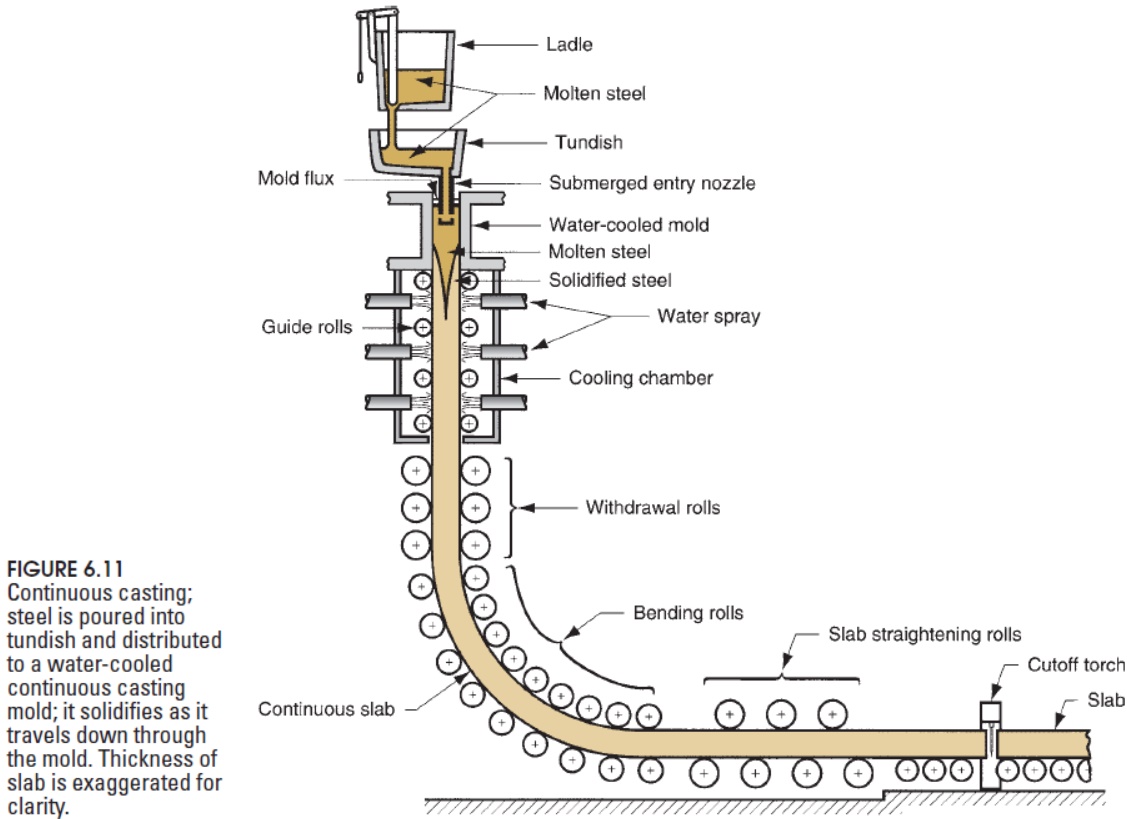
[출처: Mikell P. Groover, Fundamentals of Modern Manufacturing Materials, Processes, and Systems]