잠자리에 들다
★ call it a night 잠자리에 들다
* I also brush my teeth again before I call it a night.
* I was so tired that I called it a night earlier than usual.
* He always calls me before we call it a night.
* I also brush my teeth again before I call it a night.
* I was so tired that I called it a night earlier than usual.
* He always calls me before we call it a night.
★ crash out (피로로) 금세 잠이 들다, 잠에 빠지다
* He didn't mind crashing out in his friend's living room during his visit. 그는 친구 집에 가면 거실에서 자는것도 개의치 않았다.
★ go to bed 잠자리에 들다
* It's time for me to go to bed. 난 이제 잠잘 시간이다.
* I usually go to bed before midnight.
* I go to bed around midnight. That's the usual time I retire. 나는 자정쯤 잠자리에 든다. 그때가 보통 내가잠에 드는 시간이야.
★ go to bed 잠자리에 들다
* It's time for me to go to bed. 난 이제 잠잘 시간이다.
* I usually go to bed before midnight.
* I go to bed around midnight. That's the usual time I retire. 나는 자정쯤 잠자리에 든다. 그때가 보통 내가잠에 드는 시간이야.
★ go to bed with the chickens [입말] 일찍 잠자리에 들다.
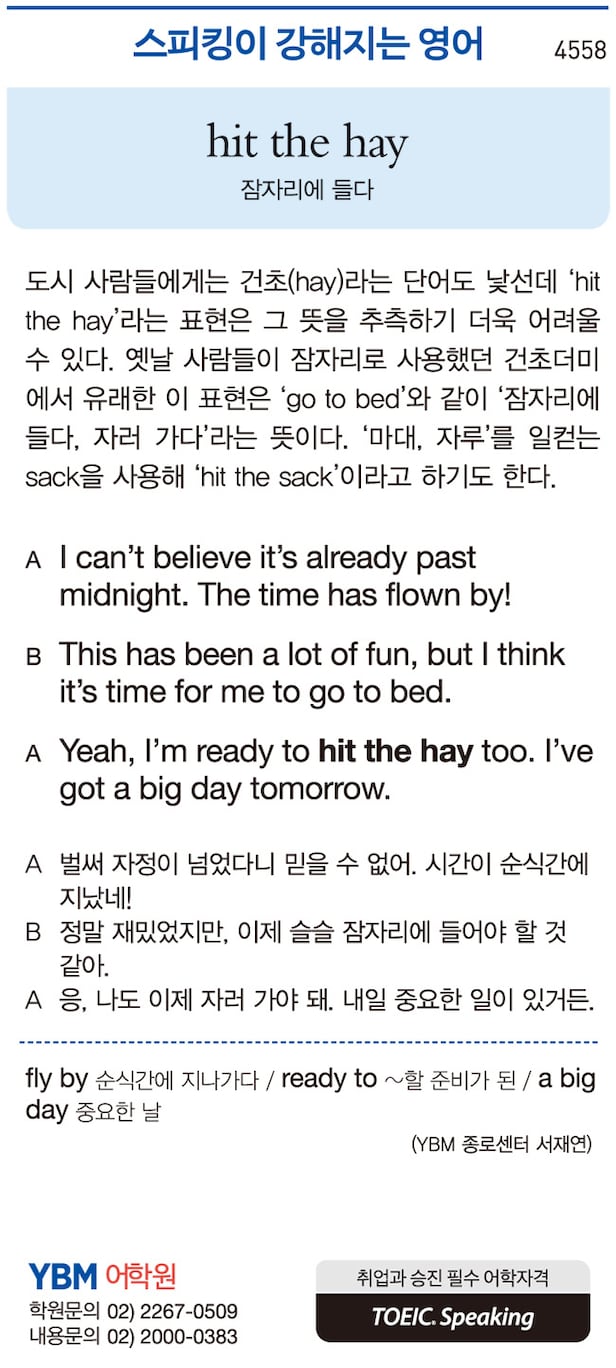
★ hit the hay 잠자리에 들다, 자다.
★ hit[or knock] the pad [입말] 잠자리에 들다, 자다.
★ hit the pillow 잠자리에 들다, 잠을 청하려고 눕다
* Is your sleep not what it used to be? Does your mind race when your head hits the pillow? Do you wake up at 4 a.m. and struggle to fall back asleep? Are you feeling drowsy and sleep-deprived no matter how many hours you spend in bed?
* Is your sleep not what it used to be? Does your mind race when your head hits the pillow? Do you wake up at 4 a.m. and struggle to fall back asleep? Are you feeling drowsy and sleep-deprived no matter how many hours you spend in bed?
★ hit the sack (= hit the hay) 잠자리에 들다.
* I brush my teeth before I hit the sack at night.
* I was so tired that I hit the sack immediately.
* I wanted to hit the sack, but I had too much work to do.
* I try not to hit the sack too late.
* I hit the sack early because I was so tired.
* I'm going to hit the hay— I’ve got to get up early in the morning. 나는 잠자러 갈 거야. 아침에 일찍 일어나야 하거든.
A: Honey, I'm going to hit the sack now.
B: OK, you go ahead. I'll hit the hay a little later.
B: OK, you go ahead. I'll hit the hay a little later.
A: 여보, 저 지금 자야겠어요.
B: 먼저 자요. 난 조금 있다가 잘게요.
A: My job at the bank is only an avocation, but it is wearing me out.
B: You look tired. Don't you want to rest from work?
A: Not really. I just need to hit the sack!
A: 은행 일은 부업일 뿐인데도 저를 지치게 만드네요.
B: 피곤해 보이세요. 일을 쉬시는 건 어떠세요?
A: 아니오. 그냥 잠이 모자란 것 같아요.
★ retire [입말] 잠자리에 들다
* My wife was really tired and retired early that night.
★ sack out 자다, 잠자리에 들다.
* Well, it's time to sack out. (아이들에게) 자, 잘 시간이야.
★ turn in 잠자리에 들다 (enter one's bed=go to sleep, go to bed)
* The Kims always turn in after watching the eleven o'clock news.
* When do you generally go to sleep at night?
* Nancy was so tired that she couldn't wait to go to bed. 정말 잠자리에 들고 싶었다.
★ turn in 잠자리에 들다 (enter one's bed=go to sleep, go to bed)
* The Kims always turn in after watching the eleven o'clock news.
* When do you generally go to sleep at night?
* Nancy was so tired that she couldn't wait to go to bed. 정말 잠자리에 들고 싶었다.
* He always turns in after watching the evening news. 그는 언제나 저녁 뉴스를 보고 잠자리에 든다.
A: What time do you usually turn in?
B: I don't go to bed until after midnight.
B: I don't go to bed until after midnight.
A: 보통 몇 시에 잠자리에 드니?
B: 자정이 지나서야 잠자리에 들어.