재단 (裁斷) 2
[뜻] 옷감이나 재목 따위를 치수에 맞도록 재거나 자르는 일.
[양복 따위의] cutting; a cut.
잘된[신통찮은] 재단 a good[bad] cut.
잘된[신통찮은] 재단 a good[bad] cut.
재단이 잘 되어서 몸에 꼭 맞는다 It is a very good cut, and a perfect fit.
이 옷의 재단은 마음에 들지 않는다 I don't like the cut of this coat.
재단이 서투른 상의 a coat of poor cut.
이 옷의 재단은 마음에 들지 않는다 I don't like the cut of this coat.
재단이 서투른 상의 a coat of poor cut.
★ cutting 절단, 재단
In tailoring, separating means the cutting of single or various textile fabrics (layers) according to measures or patterns. The basic operation of “cutting” is separation. Common characteristics of all separation processes of solid fabrics are the local destruction of material by exceeding mechanical or thermal fabric values. Figure 10.2 shows a classification of cutting processes for textile fabrics. Cropping or cutting with blades uses physical effects of mechanical separation processes. Easy-to-use cutting machines that work according to the cropping principle are normally done cutting with blades with a counter edge. Straight-knife cloth cutters are used for the cutting of ply packs with smaller sizes (rough cut). An endless knife moves up and down to cut the fabric. Particularly for thick fabric packs for the cutting of multiple layer fabrics and the so-called fine cut (previously rough cut), rotation hoop knife machines are used. They work with a continual knife that is vertically guided through the fabric layers. Cropping, also known as punching, is used for repeating components with the corresponding lot sizes. One advantage of this cutting process is the dimensional accuracy that is achievable. One has to distinguish between edged and crossed cutting.
In terms of this process the rotational cutting especially has to be mentioned for crossing cuttings.
In terms of this process the rotational cutting especially has to be mentioned for crossing cuttings.
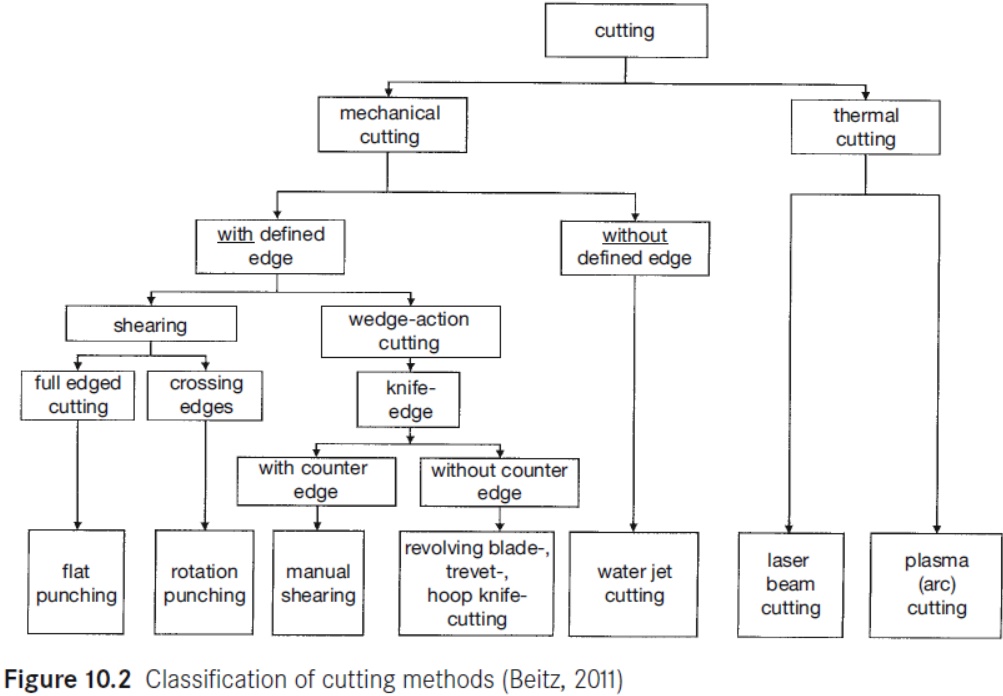
[출처: Thomas Gries et al., Textile Technology, 2nd Ed., HANSER]