저항 용접
★ resistance welding 저항 용접(抵抗鎔接)
[뜻] 접합하는 모재의 접촉부를 통해서 통전하여 발생하는 저항열을 이용해서 가열한 다음 압력을 가해서 용접하는 방법. 용접모재에 큰전류를 흘려서, 접합부의 접촉저항에 의한 발열에 의해 용접 모재를 가열하여 용융상태로 만들고 기계적 압력을 가해서 용접하는 방법이다. 용접방법에 따라 맞대기 용접ㆍ점 용접ㆍ심 용접 등이 있다.
[뜻] 접합하는 모재의 접촉부를 통해서 통전하여 발생하는 저항열을 이용해서 가열한 다음 압력을 가해서 용접하는 방법. 용접모재에 큰전류를 흘려서, 접합부의 접촉저항에 의한 발열에 의해 용접 모재를 가열하여 용융상태로 만들고 기계적 압력을 가해서 용접하는 방법이다. 용접방법에 따라 맞대기 용접ㆍ점 용접ㆍ심 용접 등이 있다.
Resistance welding achieves coalescence using heat from electrical resistance to the fl ow of a current passing between the faying surfaces of two parts held together under pressure.
Resistance welding (RW) is a group of fusion-welding processes that uses a combination of heat and pressure to accomplish coalescence, the heat being generated by electrical resistance to current fl ow at the junction to be welded. The principal components in resistance welding are shown in Figure 29.12 for a resistance spotwelding operation, the most widely used process in the group. The components include
work parts to be welded (usually sheet metal parts), two opposing electrodes, a means of applying pressure to squeeze the parts between the electrodes, and an AC power supply from which a controlled current can be applied. The operation results in a fused zone between the two parts, called a weld nugget in spot welding.
work parts to be welded (usually sheet metal parts), two opposing electrodes, a means of applying pressure to squeeze the parts between the electrodes, and an AC power supply from which a controlled current can be applied. The operation results in a fused zone between the two parts, called a weld nugget in spot welding.
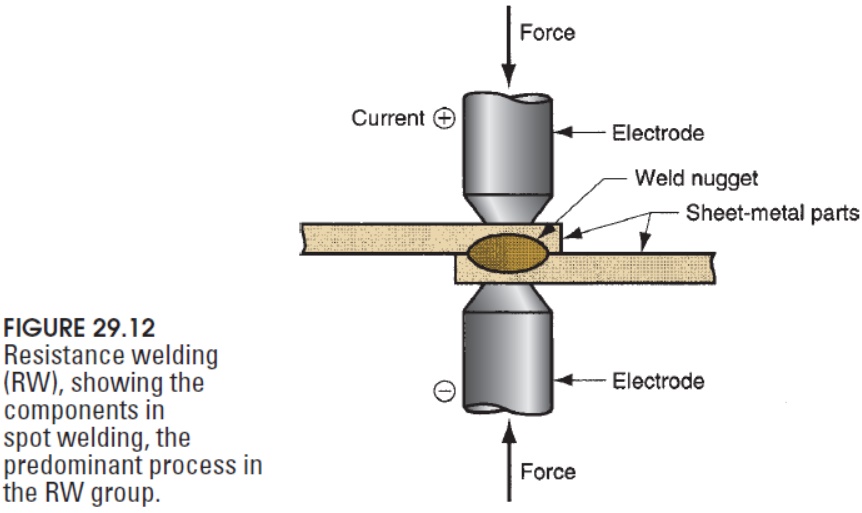
[출처: Mikell P. Groover, Fundamentals of Modern Manufacturing Materials, Processes, and Systems]