전기화학전지
★ electrochemical cell 전기화학전지.
[뜻] 화학 반응을 통해 전기 에너지를 발생시키거나 전기 에너지를 사용하여 화학 반응을 일으키는 장치.
* An electrochemical cell should not be confused with an electrolytic cell, which is powered by an external source of electricity to promote electrolysis, whereby chemical compounds are broken down to their constituent elements. An electrolytic cell thus consumes electricity, while an electrochemical cell produces electricity. . . . In a basic battery design often used for demonstration purposes, a piece of copper serves as an electrode, partially immersed in a solution of copper sulfate, while a piece of zinc forms a second
electrode, partially immersed in a solution of zinc sulfate. Each sulfate solution is known as an electrolyte,
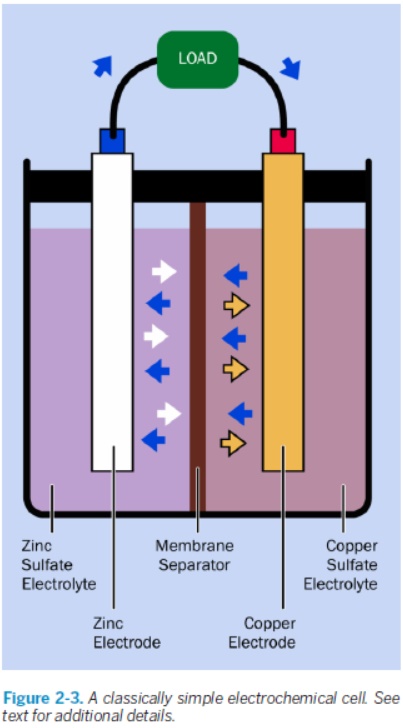
the complete battery may be referred to as a cell, and each half of it may be termed a halfcell. A simplified cross-section view is shown in Figure 2-3. Blue arrows show the movement of electrons from the zinc terminal (the anode), through an external load, and into a copper terminal (the cathode). A membrane separator allows the electrons to circulate back through the battery, while preventing electrolyte mixing.
Orange arrows represent positive copper ions. White arrows represent positive zinc ions. (An ion is an atom with an excess or deficit of electrons.) The zinc ions are attracted into the zinc sulfate electrolyte, resulting in a net loss of mass from the zinc electrode. Meanwhile, electrons passing into the copper
electrode tend to attract positive copper ions, shown as orange arrows in the diagram. The copper
ions are drawn out of the copper sulfate electrolyte, and result in a net accumulation of copper
atoms on the copper electrode. This process is energized partially by the fact that zinc tends to lose electrons more easily than copper.
[출처: Charles Platt, Encyclopedia of Electronic Components Volume 1 Resistors, Capacitors, Inductors, Switches, Encoders, Relays, Transistors]