전압 조정기
★ voltage regulator 전압 조정기.
* The voltage delivered by a battery will be pulled down significantly when a load is applied to it, and will decrease further as time passes during a discharge cycle. For these reasons, a voltage regulator is required when a battery powers components such as digital integrated circuit chips, which do not tolerate a wide variation in voltage.
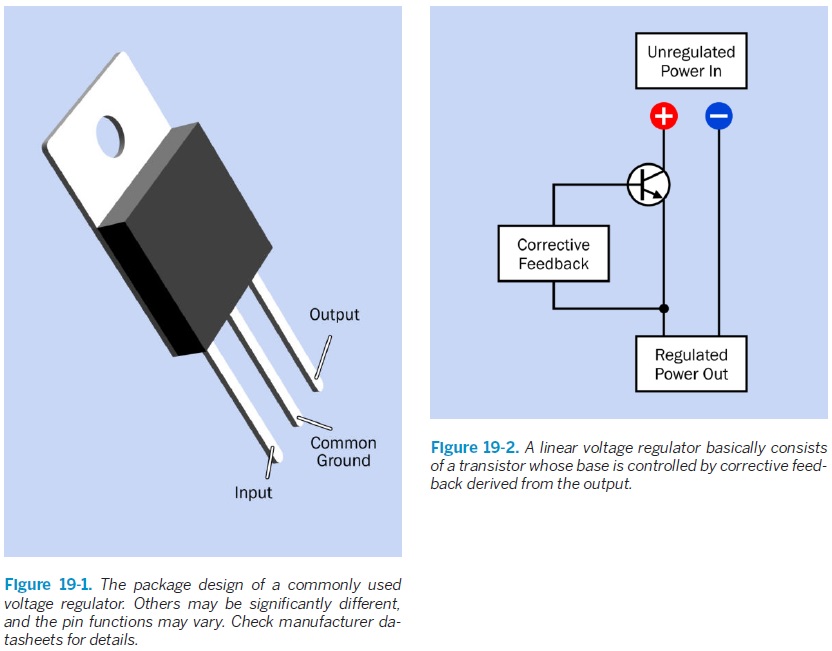
* Correctly known as a linear voltage regulator to distinguish it from a switching regulator or DC-DC converter. However, the full term is not generally used, and “voltage regulator” is normally understood to mean a linear voltage regulator. . . . A linear voltage regulator provides a tightly controlled DC output, which it derives from an unregulated or poorly regulated DC input. The DC output remains constant regardless of the load on the regulator (within specified limits). It is a cheap, simple, and extremely robust component. There is no single schematic symbol for a linear voltage regulator. The general physical appearance of a commonly used type of regulator, rated for an output of around 1A DC, is shown at Figure 19-1.
[출처: Charles Platt, Encyclopedia of Electronic Components Volume 1 Resistors, Capacitors, Inductors, Switches, Encoders, Relays, Transistors]