전위차계
★ potentiometer 전위차계(電位差計), 가변 저항기.
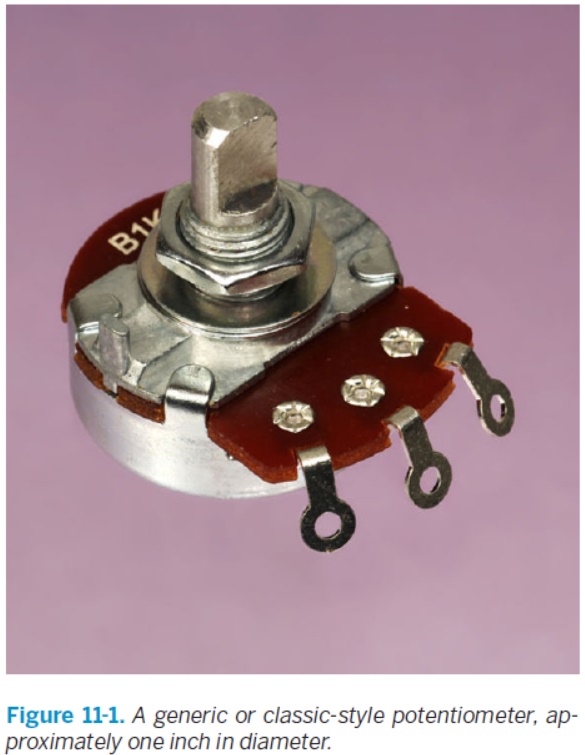
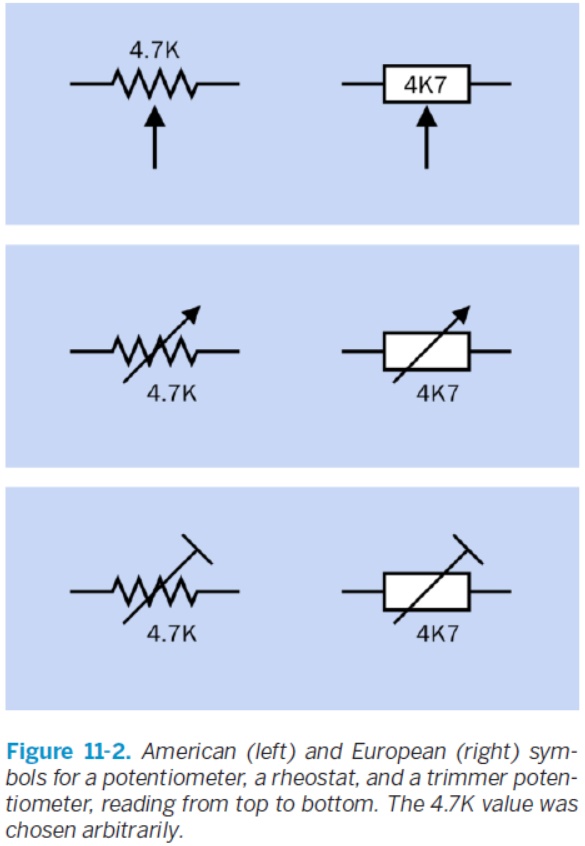
Also known as a variable resistor; may be substituted for a rheostat. When a voltage is applied across a potentiometer, it can deliver a variable fraction of that voltage. It is often used to adjust sensitivity, balance, input, or output, especially in audio equipment and sensors such as motion detectors. A potentiometer can also be used to insert a variable resistance in a circuit, in which case it should really be referred to as a variable resistor, although most people will still call it a potentiometer. It can be used to adjust the power supplied to a circuit, in which case it is properly known as a rheostat, although this term is becoming obsolete. Massive rheostats were once used for purposes such as dimming theatrical lighting, but solid-state components have taken their place in most high-wattage applications. A full-size, classic-style potentiometer is shown in Figure 11-1.
A potentiometer has three terminals. The outer pair connect with the opposite ends of an internal
resistive element, such as a strip of conductive plastic, sometimes known as the track. The third center terminal connects internally with a contact known as the wiper (or rarely, the pickoff), which touches the strip and can be moved from one end of it to the other by turning a shaft or screw, or by moving a slider.
resistive element, such as a strip of conductive plastic, sometimes known as the track. The third center terminal connects internally with a contact known as the wiper (or rarely, the pickoff), which touches the strip and can be moved from one end of it to the other by turning a shaft or screw, or by moving a slider.
[출처: Charles Platt, Encyclopedia of Electronic Components Volume 1 Resistors, Capacitors, Inductors, Switches, Encoders, Relays, Transistors]