정수압 압출
★ hydrostatic extrusion 정수압 압출(법)(靜水壓押出)
[뜻] 빌렛의 주위에 고압의 액체가 개재하므로 용기와 빌랫 사이의 마찰이 없이 다이스와 빌렛 사이의 윤활이 유체윤활에 가까운 특징을 갖는다. 압출압력은 10000~15000㎏/㎠며, 압력 매체는 동식물유가 좋고, 점도의 압력계수가 작아서 상온 상압 점도가 큰 피마자유 등이 좋다. 공업적으로는 최소의 압력매체를 써서 될 수 있는 한 큰 압출비로서 가공할 필요가 있으며, 유막을 이용한 하이드라 필름법(hydrafilm)은 정수압 압출이 종래의 윤활 램 압출에 가까운 것이다. 압출 속도는 빠른 쪽이 제품 치수의 정밀도가 좋다. 또, 압출비가 크지 않아도 제품의 밀도가 거의 변하지 않고, 연성이 높은 제품이 쉽게 얻어진다. 그리고 압출비가 10 이하에서는 가공도와 함께 강도가 상승하고, 연성은 저하하는데 압출비가 10을 넘으면 가공중의 온도 상승 때문에 강도가 저하하여 연성이 늘어나는 경향이 있다.
[뜻] 빌렛의 주위에 고압의 액체가 개재하므로 용기와 빌랫 사이의 마찰이 없이 다이스와 빌렛 사이의 윤활이 유체윤활에 가까운 특징을 갖는다. 압출압력은 10000~15000㎏/㎠며, 압력 매체는 동식물유가 좋고, 점도의 압력계수가 작아서 상온 상압 점도가 큰 피마자유 등이 좋다. 공업적으로는 최소의 압력매체를 써서 될 수 있는 한 큰 압출비로서 가공할 필요가 있으며, 유막을 이용한 하이드라 필름법(hydrafilm)은 정수압 압출이 종래의 윤활 램 압출에 가까운 것이다. 압출 속도는 빠른 쪽이 제품 치수의 정밀도가 좋다. 또, 압출비가 크지 않아도 제품의 밀도가 거의 변하지 않고, 연성이 높은 제품이 쉽게 얻어진다. 그리고 압출비가 10 이하에서는 가공도와 함께 강도가 상승하고, 연성은 저하하는데 압출비가 10을 넘으면 가공중의 온도 상승 때문에 강도가 저하하여 연성이 늘어나는 경향이 있다.
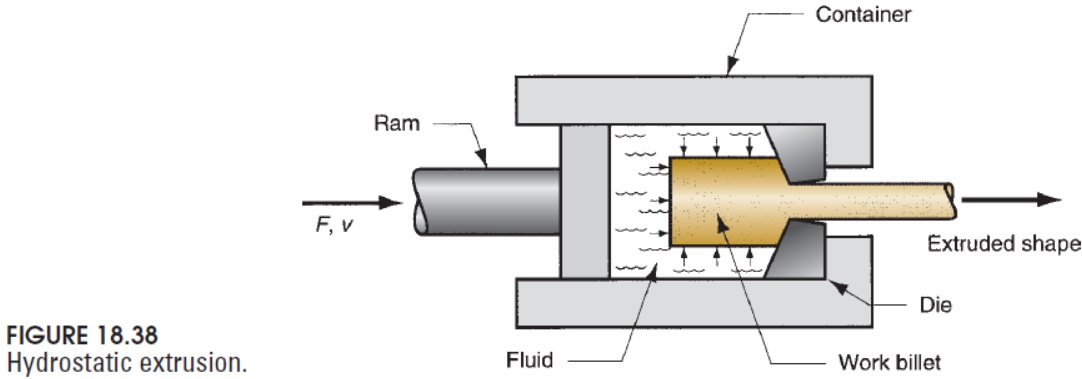
One of the problems in direct extrusion is friction along the billet–container interface. This problem can be addressed by surrounding the billet with fl uid inside the container and pressurizing the fl uid by the forward motion of the ram, as in Figure 18.38. This way, there is no friction inside the container, and friction at the die opening is reduced. Consequently, ram force is signifi cantly lower than in direct extrusion. The fl uid pressure acting on all surfaces of the billet gives the process its name. It can be carried out at room temperature or at elevated temperatures. Special fl uids and procedures must be used at elevated temperatures. Hydrostatic extrusion is an adaptation of direct extrusion.
Hydrostatic pressure on the work increases the material’s ductility. Accordingly, this process can be used on metals that would be too brittle for conventional extrusion operations. Ductile metals can also be hydrostatically extruded, and high reduction ratios are possible on these materials. One of the disadvantages of the process is the required preparation of the starting work billet. The billet must be formed with a taper at one end to fi t snugly into the die entry angle. This establishes a seal to prevent fluid from squirting out the die hole when the container is initially pressurized.
Hydrostatic pressure on the work increases the material’s ductility. Accordingly, this process can be used on metals that would be too brittle for conventional extrusion operations. Ductile metals can also be hydrostatically extruded, and high reduction ratios are possible on these materials. One of the disadvantages of the process is the required preparation of the starting work billet. The billet must be formed with a taper at one end to fi t snugly into the die entry angle. This establishes a seal to prevent fluid from squirting out the die hole when the container is initially pressurized.
[출처: Mikell P. Groover, Fundamentals of Modern Manufacturing Materials, Processes, and Systems]