정확도 (精確度)
◼ Accuracy vs. Precision
Accuracy refers to the closeness of a measured value to a standard or known value. For example, if in lab you obtain a weight measurement of 3.2 kg for a given substance, but the actual or known weight is 10 kg, then your measurement is not accurate. In this case, your measurement is not close to the known value.
Precision refers to the closeness of two or more measurements to each other. Using the example above, if you weigh a given substance five times, and get 3.2 kg each time, then your measurement is very precise. Precision is independent of accuracy. You can be very precise but inaccurate, as described above. You can also be accurate but imprecise.
aCcurate is Correct (a bullseye).
pRecise is Repeating (hitting the same spot, but maybe not the correct spot)
* Accuracy and precision are two ways to gauge the quality of a set of measured numbers. Although the difference between the two terms may be subtle, it is important. Accuracy tells us how close a measurement is to the true value. Precision tells us how close multiple measurements of the same thing are to one another (Figure 1.12).
Suppose that three students are asked to determine the mass of an aspirin tablet. Each student weighs the aspirin tablet three times. The results (in grams) are
Suppose that three students are asked to determine the mass of an aspirin tablet. Each student weighs the aspirin tablet three times. The results (in grams) are
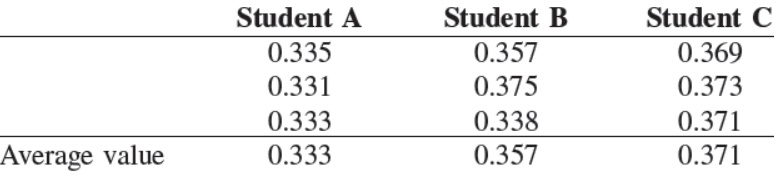
The true mass of the tablet is 0.370 g. Student A’s results are more precise than those of student B, but neither set of results is very accurate. Student C’s results are both precise (very small deviation of individual masses from the average mass) and accurate (average value very close to the true value). Figure 1.13 shows all three students’ results in relation to the true mass of the tablet. Highly accurate measurements are usually precise, as well, although highly precise measurements do not necessarily guarantee accurate results. For example, an improperly calibrated meterstick or a faulty balance may give precise readings that are significantly different from the correct value.
[출처: Chemistry by Julia R. Burdge]
★ degree of accuracy
★ accuracy 정확도, 정확성; [물리, 화학] 정밀도(精密度)(precision) (= the fact of being exact or correct).
* a high degree of accuracy 고도의 정확성.
* for accuracy 정확을 기해[기하기 위해].
* with accuracy 정확하게.
* Accuracy is how close a measured value is to the actual (true) value.
★ precision (= the quality of being exact) 정확(성)
* with precision 정확히
* Precision is how close the measured values are to each other.

* Precision is how close the measured values are to each other.
★ veracity (the ~) (감각·과학 기구 따위의) 정확성, 정확도