주조 결함
★ casting defects 주조 결함.
[뜻] 주물 표면에 나타난 불량.
Casting Defects Some defects are common to any and all casting processes. These defects are illustrated in Figure 11.24 and briefly described in the following:
(a) Misruns, which are castings that solidify before completely filling the mold cavity. Typical causes include (1) fluidity of the molten metal is insufficient, (2) pouring temperature is too low, (3) pouring is done too slowly, and/or (4) cross section of the mold cavity is too thin.
(b) Cold Shuts, which occur when two portions of the metal flow together but there is a lack of fusion between them due to premature freezing. Its causes are similar to those of a misrun.
(c) Cold shots, which result from splattering during pouring, causing the formation of solid globules of metal that become entrapped in the casting. Pouring procedures and gating system designs that avoid splattering can prevent this defect.
(d) Shrinkage cavity is a depression in the surface or an internal void in the casting, caused by solidification shrinkage that restricts the amount of molten metal available in the last region to freeze. It often occurs near the top of the casting, in which case it is referred to as a “pipe.” See Figure 10.8(3). The problem can often be solved by proper riser design.
(e) Microporosity consists of a network of small voids distributed throughout the casting caused by localized solidification shrinkage of the final molten metal in the dendritic structure. The defect is usually associated with alloys, because of the protracted manner in which freezing occurs in these metals.
(f) Hot tearing, also called hot cracking, occurs when the casting is restrained from contraction by an unyielding mold during the final stages of solidification or early stages of cooling after solidification. The defect is manifested as a separation of the metal (hence, the terms tearing and cracking) at a point of high tensile stress caused by the metal’s inability to shrink naturally. In sand casting and other expendable-mold processes, it is prevented by compounding the mold to be collapsible. In permanent-mold processes, hot tearing is reduced by removing the part from the mold immediately after solidification.
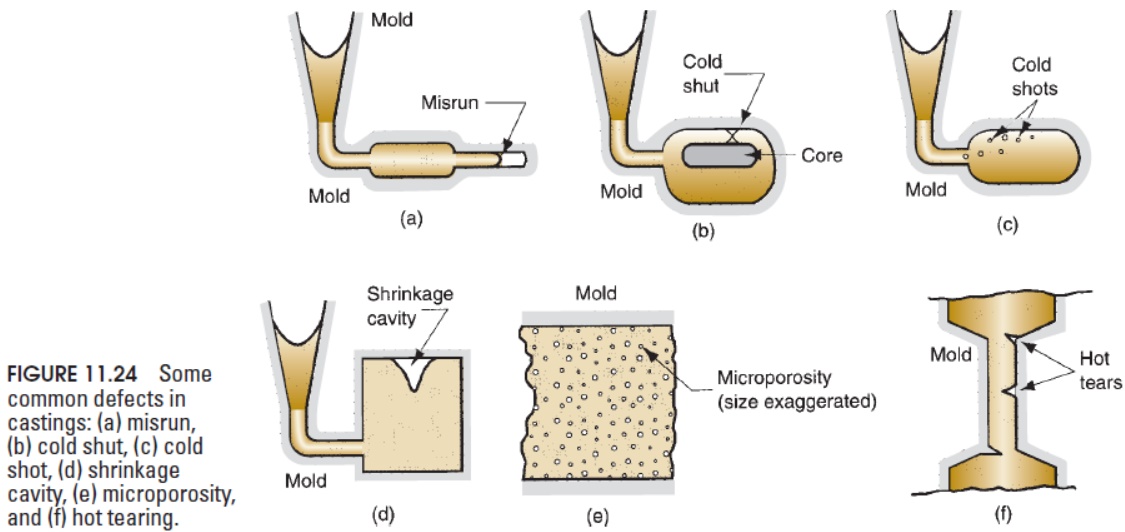
[출처: Mikell P. Groover, Fundamentals of Modern Manufacturing Materials, Processes, and Systems]