직류-직류 변환기
★ DC-DC converter [전기] 직류-직류 변환기.
Often referred to as a switching regulator, and sometimes as a switcher, not to be confused with a switching power supply. . . . A DC-DC converter, often referred to simply as a converter, receives a DC voltage as its input and converts it to a regulated DC voltage as its output. The output voltage may be higher or lower than the input voltage, may be user-adjustable by adding an external resistor, and may be completely electrically isolated from the input, depending on the type of converter that is used. The overall efficiency is not greatly affected by the difference between input and output voltage, and can exceed 90%, minimizing waste heat and enabling the unit to be extremely compact. A DC-DC converter is an integrated circuit package that includes a high-speed switching device (almost always, a MOSFET) in conjunction with an oscillator circuit, an inductor, and a diode. By comparison, a linear regulator is usually based around bipolar transistors. Its input must always be at a higher voltage than its output, and its efficiency will be inversely proportional with the voltage drop that it imposes. See the voltage regulator entry in this encyclopedia for additional information.
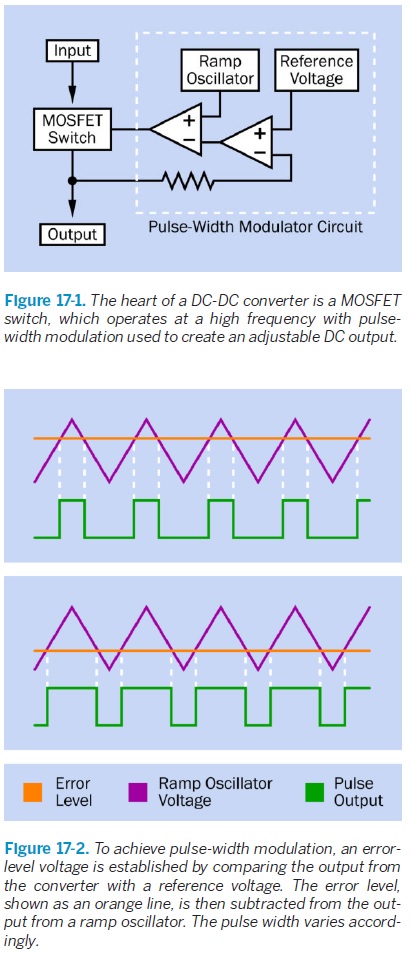
[출처: Charles Platt, Encyclopedia of Electronic Components Volume 1 Resistors, Capacitors, Inductors, Switches, Encoders, Relays, Transistors]