질량 분광계
mass spectrometry
★ mass spectrometer
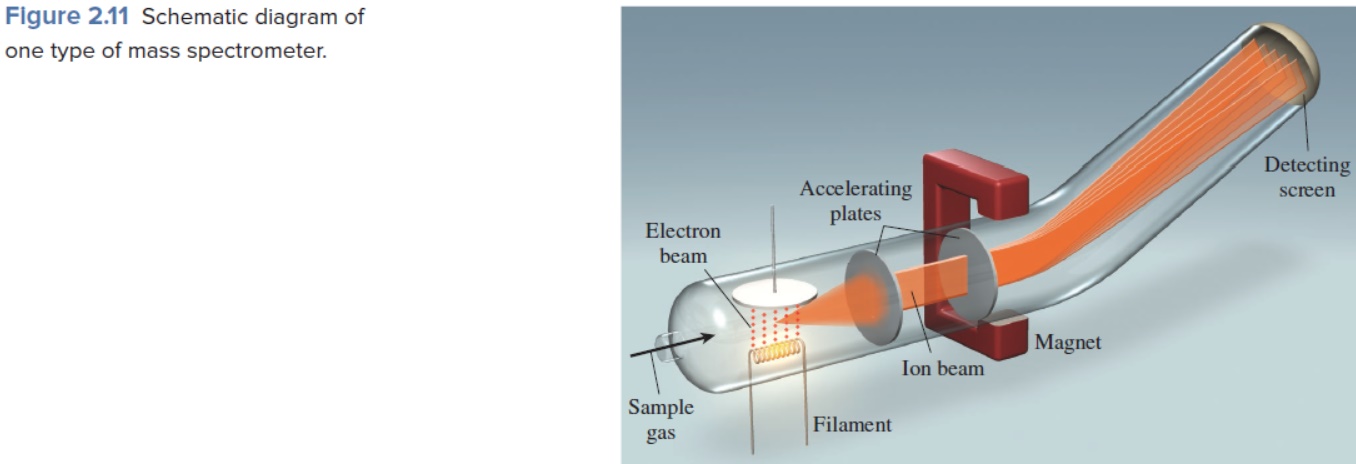
* The most direct and most accurate method for determining atomic and molecular masses is mass spectrometry. In a mass spectrometer, such as that depicted in Figure 2.11, a gaseous sample is bombarded by a stream of high-energy electrons. Collisions between the electrons and the gaseous atoms (or molecules) produce positively charged species, called ions, by dislodging an electron from the atoms or molecules. These positive ions (of mass m and charge e) are accelerated as they pass through two oppositely charged plates. The emerging ions are deflected into a circular path by a magnet. The radius of the path depends on the charge-to-mass ratio (i.e., e/m). Ions with a small e/m ratio trace a wider arc than those having a larger e/m ratio, so ions with equal charges but different masses are separated from one another. The mass of each ion (and hence its parent atom or molecule) is determined from the magnitude of its deflection. Eventually the ions arrive at the detector, which registers a current for each type of ion. The amount of current generated is directly proportional to the number of ions, so it enables us to determine the relative abundance of isotopes.
[출처: Chemistry by Julia R. Burdge]